

What a year of the other options costs
It Is The Cheapest Thing On This List, And The Only One You Buy Once.
Nobody is telling you a cushion replaces a seat, a chiropractor or a therapist. But every line below is priced the same way - what it costs you over one year - because that is the only way these numbers can be compared honestly.
The truck-stop pad, again
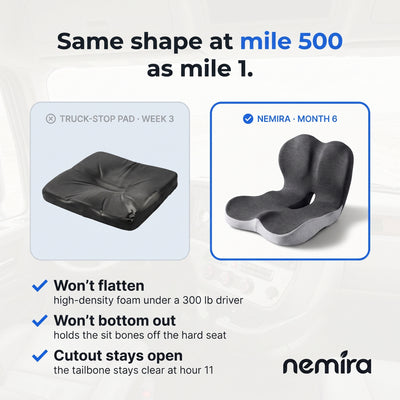
The one you have already bought. Low-density foam under a 280 lb driver on a seat that never stops moving mashes flat in about three weeks, so it quietly becomes a subscription you never signed up for.
Every 3-4 weeksSwapping the seat itself
Two problems. Most company drivers are not permitted to modify the truck. And NIOSH measured a brand-new air-ride seat removing only about a tenth of the floor vibration - it absorbs the craters and passes the rest straight up, into the same tailbone.
One time, if allowedChiropractor, weekly
52 visits a year. Even at twice a month it is $1,800-$3,600 - and every one of them needs you off the road, in the right town, on the right day.
Every weekA year of physical therapy
Two six-week courses at twice a week, the usual pattern for low back pain. Insured, a $30-$50 copay still leaves you $720-$1,200 down over the year.
24 visits a yearCarrying on as you are
The option you are already running. It is free right up until it isn't, and it never sends you a bill you can point at.
OngoingWhat the free option actually bills you
Month 3
Painkillers and patches become a line item you stop noticing. $120-$300 a year, every year.
Month 8
You start choosing runs by how long you will be sat down, not by what they pay.
Year 1
You turn down the long one. A single refused haul is $400-$900 you will not get back.
Year 2
The DOT physical stops being a formality and starts being the appointment you dread.
Nemira - 3 cushions
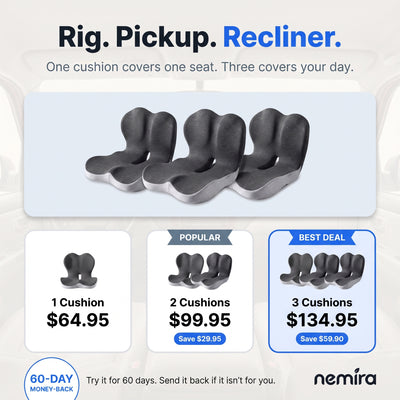
That is $44.98 each. One lives in the cab, one in the pickup, one in the recliner - nothing to carry between them, nothing to forget at 5am. 60 days to prove it on the road. Ships free.
Once. Nothing to re-buy
Adds the 3-cushion pack. 60 days to send it back.
- 60-day guarantee
- Free shipping on 2+
- OEKO-TEX certified foam
Priced against one Nemira three-pack
Nemira is 37 cents a day for the first year - and that is all 3 cushions, not one. $134.95 once, less than a tank of diesel, and nobody has to approve it.
Alternative costs are typical US ranges and vary by provider, region and insurance. Seat pricing covers a replacement air-ride seat plus fitting. Visit counts are common patterns for low back pain, not a prescription. Nemira is a seat cushion, not a medical device, and does not treat, prevent or replace care for any condition.
Built For The Seat You Spend The Miles In.
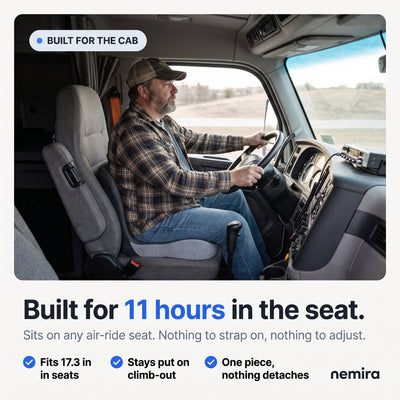
Long-haul, delivery, rideshare, or a four-hour run to see family - the seat is fixed, the road keeps arriving through it, and you cannot swap it out. It lifts out in one hand and works in every other seat you sit in after.
Not another pad. A structure.

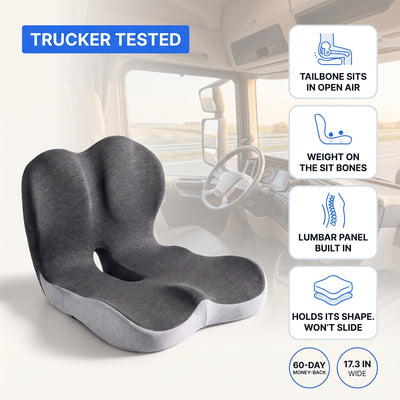
Tailbone suspended, weight on the sit bones - in a seat you cannot change.
Mile 40 You Shift. Mile 200 You Are On One Hip. Mile 400 You Are Counting Exits.
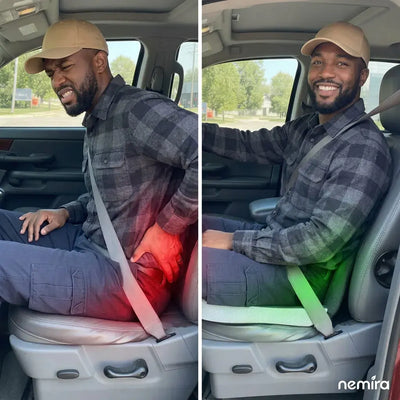
You did not get softer. The seat has no lumbar fill, your tailbone is carrying weight it was never built to carry, and the road is hitting it a few hundred times a minute.
 1
1
 2
2
 3
3
-
8:30 AM
You climb in and it feels fine. It always feels fine in the first hour - that is what makes you think the seat is not the problem.
-
10:00 AM
First shift in the seat. Weight goes onto one hip because the other side has started to ache. You are not thinking about it yet, you are just moving.
-
12:00 PM
The tailbone is a hot point of contact now - one small bone taking your whole upper body, and every seam and expansion joint arriving through it.
-
2:00 PM
You have already adjusted the seat, dumped some air out of it and moved your wallet to the door pocket. Those things help. They do not reach the tailbone.
-
4:00 PM
You are counting exits. Not because the driving is hard - because sitting has become the hard part of the drive.
-
5:30 PM
Getting out is a two-stage move. Hand on the wheel or the grab handle, straighten slowly. You started doing that without noticing when.
None of that is a willpower problem. The tailbone is taking body weight it was never built to carry, the seat leaves a hollow behind your lower back, and the road keeps arriving through both.
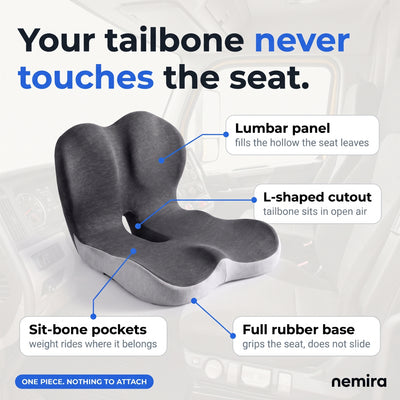
The coccyx cutout removes the contact entirely - it does not soften it. The integrated lumbar panel fills the gap so your pelvis stops rolling back, and the high-density foam is still doing both at mile 500.
It is not just you
This is measured, not anecdotal.
Sitting for a living has a documented cost, and the research is specific about who it lands on.
of truck drivers report musculoskeletal disorders
Across a systematic review and meta-analysis of the occupational health literature. Not a survey of our own customers.
report low back pain in a 12-month period
Pooled across 53 studies of professional drivers. More than half, every year.
is a documented causal factor, not a nuisance
Whole-body vibration is identified in the literature as a contributor to driver musculoskeletal disorders. The road is doing something, and it goes through your tailbone.
Sources: BMC Public Health, musculoskeletal disorders among truck drivers (systematic review and meta-analysis); pooled meta-analysis of low back pain prevalence in professional drivers, 53 studies. Nemira is a seat cushion, not a medical device, and does not treat or prevent any condition.
Roll. Sink. Road. One Body Answers All Three.
This is not about softness. It is about where your weight lands, what fills the hollow behind you, and what happens when the road keeps arriving through both.
The U-shaped cutout removes the contact
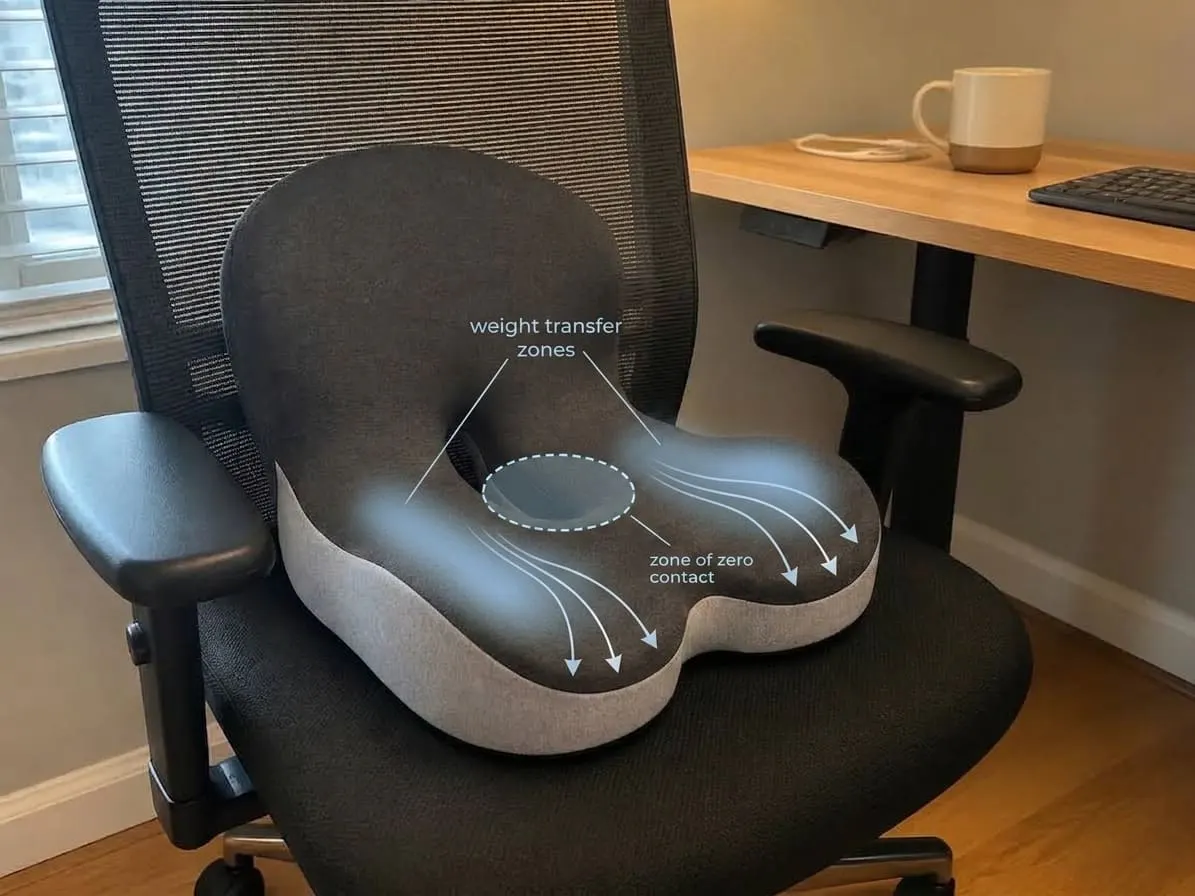
A flat pad softens the pressure on your coccyx. The cutout deletes it - the tailbone hangs over open air while the contoured platform transfers your weight outward onto the sit bones and thighs, which are built to carry it.
 Load moves outward
Lumbar hollow filled
Load moves outward
Lumbar hollow filled
The lumbar panel fills the hollow
Your seat leaves a gap behind your lower back. Empty, the pelvis rolls backward and your spine collapses into a C. The lumbar panel fills that hollow so the pelvis stays upright - and because it is the same body of foam you are sitting on, your own weight anchors it.

Empty, the pelvis rolls back and the spine folds into a C. Filled, it stays stacked.
Flat slabs failed you because they only soften the contact - they never remove it. Two-piece sets failed you because gravity always wins against a separate back cushion.
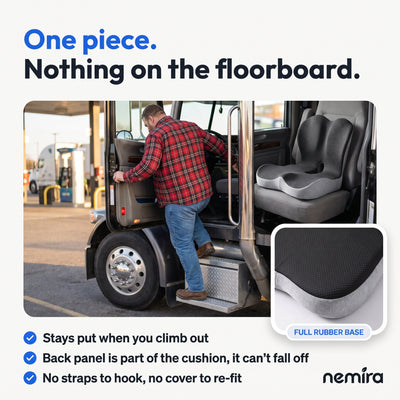
That is a design problem, not your fault. The One-Body L-Core is a single molded L-shaped piece of supportive-firm high-density memory foam. Seat and lumbar panel are the same body of foam, so there is no seam, no strap and nothing that can detach, slide or go flat independently. A two-piece set cannot do this, and a flat pad has nothing to do it with.
The Pad You Threw Away. The One That Hurt Your Back. And This.
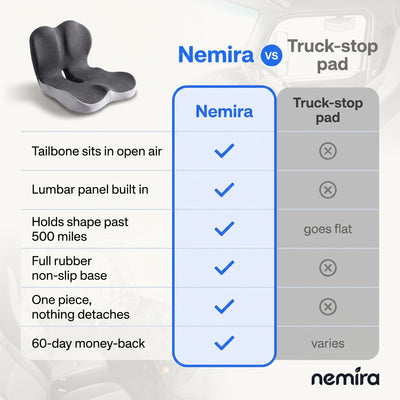
No brand names. Just the three things a driver actually ends up sitting on, and what each one does eleven hours into the 14.

The $20 truck-stop pad
Flat by week three.

The $159 gel grid
Fixes the tailbone, moves it up your back.

Nemira
One body. Tailbone over open air.
Tailbone contact
Where your weight goes
Under 250-300 lb
Stability
At 3 weeks, 500 miles
Climbing out
Fit in a truck seat
The real alternative was never another pad. It was a seat you may not be allowed to fit.
A replacement air-ride seat runs $1,400-$3,200 installed, and most company drivers are not permitted to modify the truck. NIOSH measured a brand-new air-ride seat removing only about a tenth of the floor vibration - it takes the craters and passes the rest straight up, into the same tailbone. Nemira is a cushion, not a modification. Nobody has to approve it.
Not "Better Foam." Five Things You Can Point At.
Every cushion says premium. Here is what is actually different, in words you could repeat to another driver.
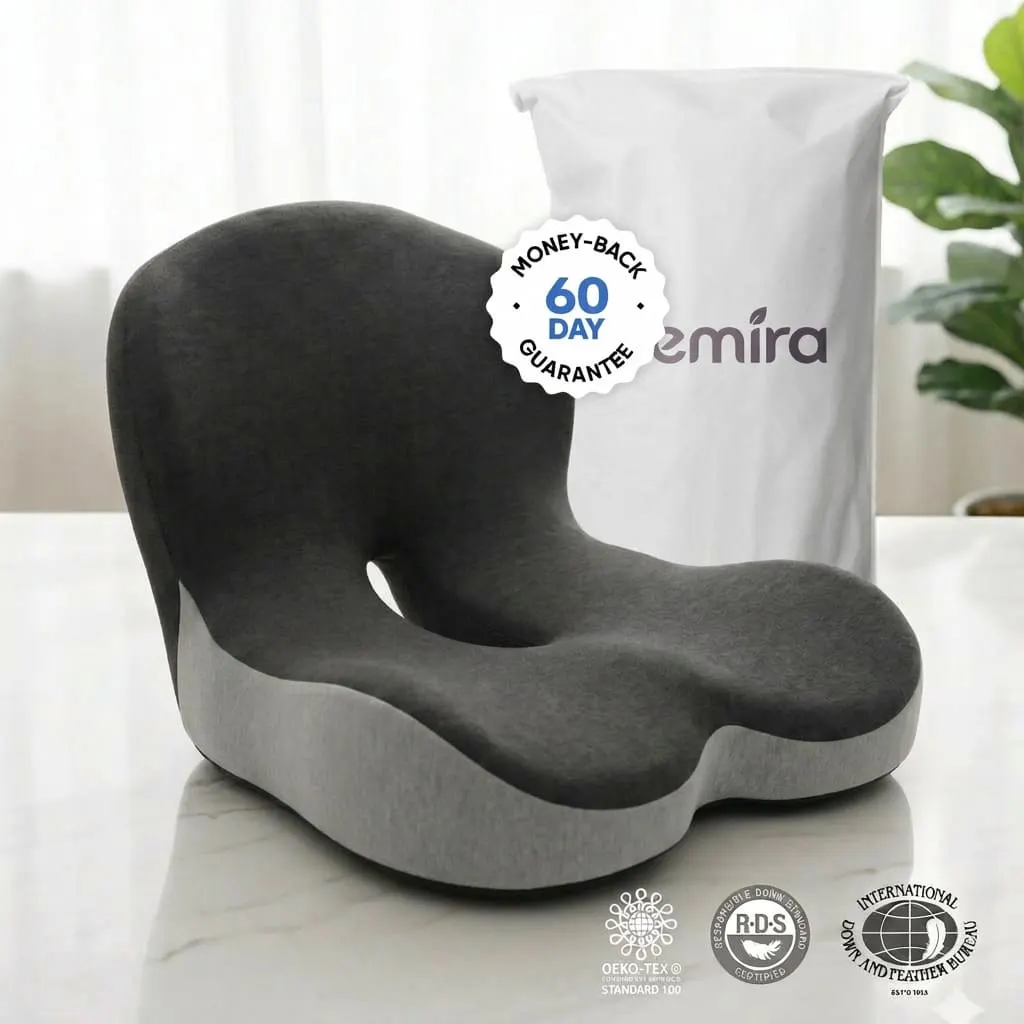
One continuous molded piece
Seat and lumbar panel are the same body. There is no strap, no clip, no second cushion. Nothing detaches, so nothing can slide down behind you on the first bump.

U-shaped coccyx cutout
The rear channel is open. Your tailbone sits over air and touches nothing at all - that is not cushioning the bone, it is taking the bone out of the equation.
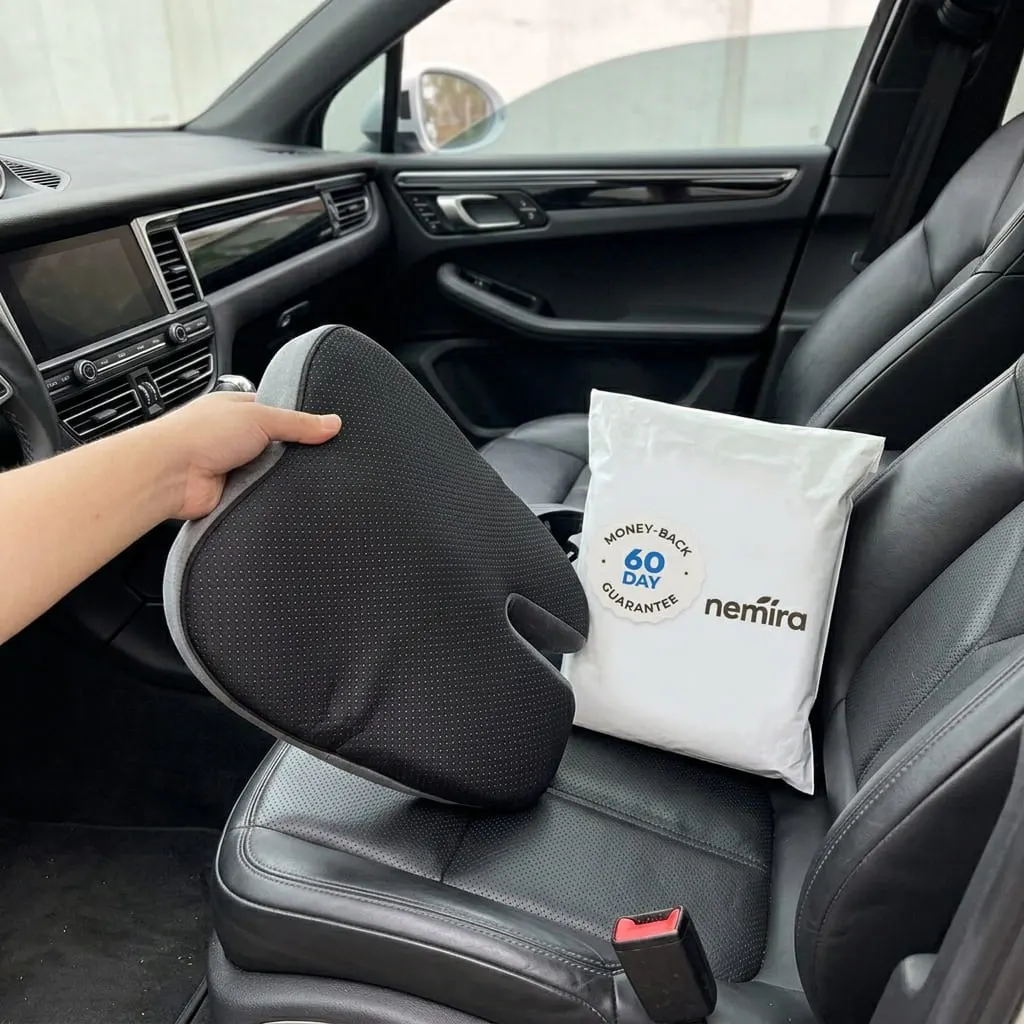
Full non-slip rubber base
The whole underside grips - not four small dots in the corners. Climb in, climb out, climb back in. It has not moved.
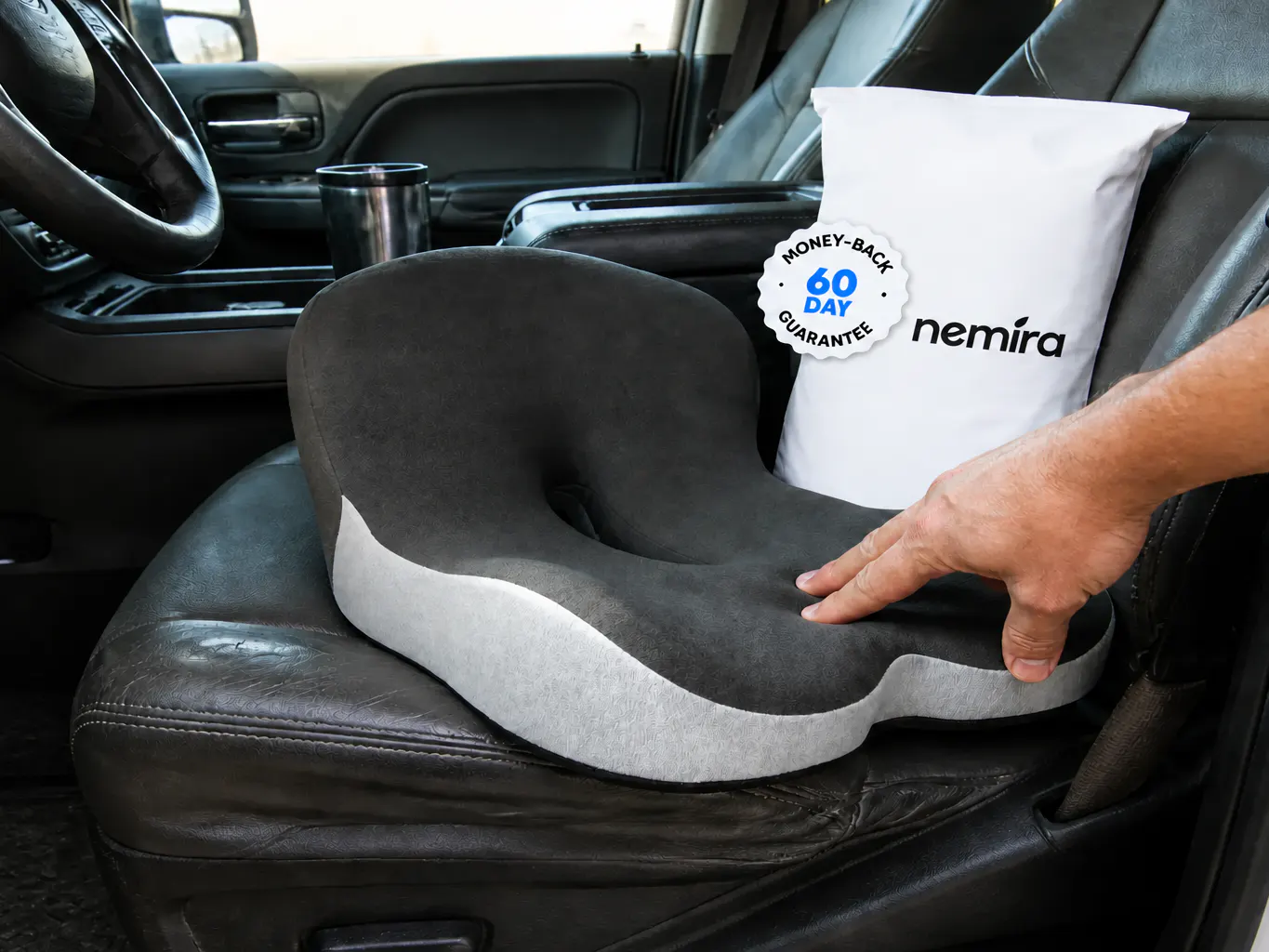
Supportive-firm high-density memory foam
Dense and firm enough that a 250 to 300 lb driver does not bottom out onto the seat beneath it - which is the exact point where a $20 pad quits. It was not proven on a lab rig. It was proven by drivers running 2,500 miles a week, who tell us the cutout is still open months in. OEKO-TEX certified.
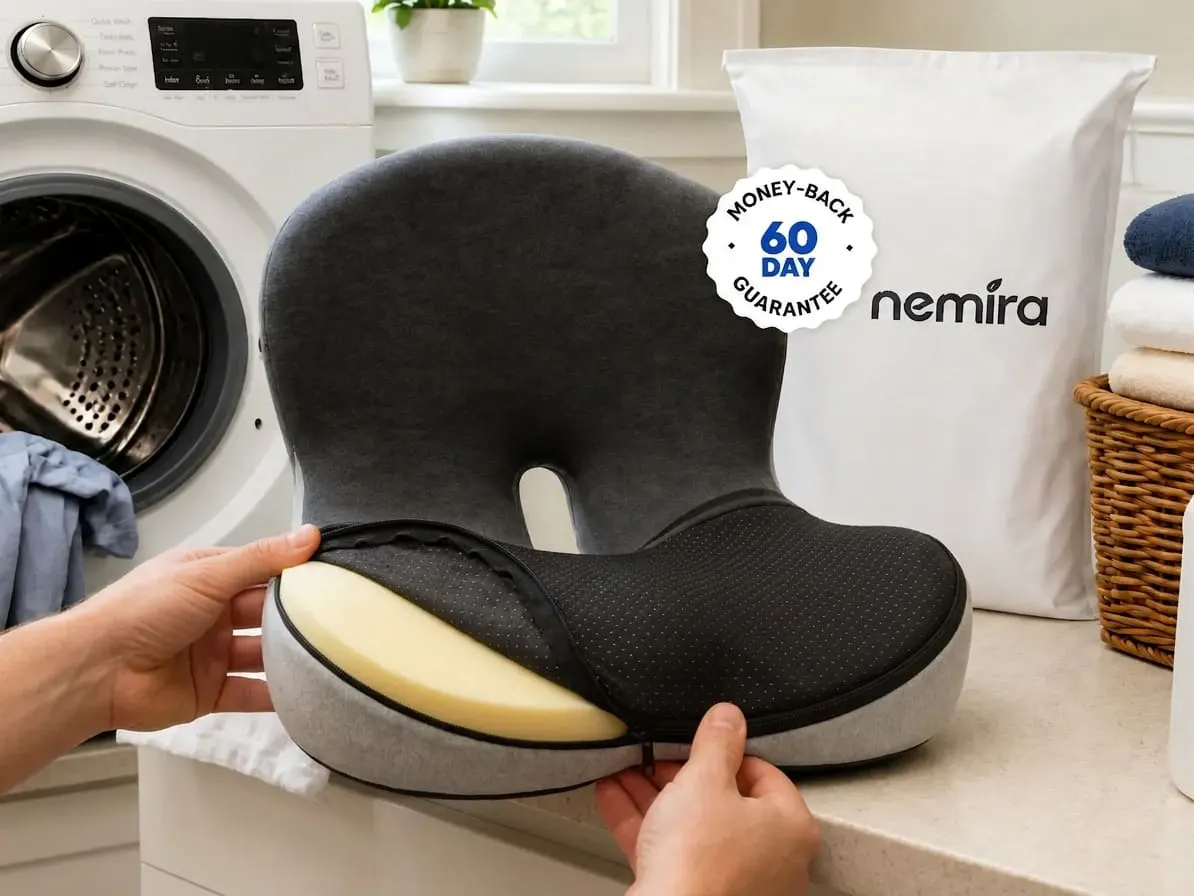
Removable machine-washable cover
Breathable knit that unzips and goes in the wash, over OEKO-TEX certified foam. You are going to sit on this eight to eleven hours a day, most days.
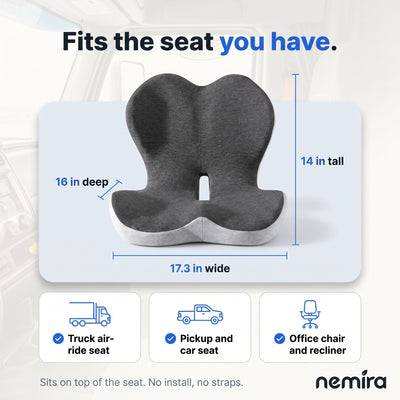
Standard size - fits a roughly 17 to 18 inch wide seat. Office chairs, dining chairs and vehicle seats.
The questions people ask after their last cushion failed
Straight answers on fit, firmness, staying put in a moving seat, and washing.
The U-shaped cutout doesn't soften the contact under your tailbone - it removes it. Your weight lands on the sit bones and thighs instead, so the coccyx touches nothing at all. At the same time the lumbar panel fills the hollow your chair leaves at your lower back, which stops the pelvis rolling backward into a slump.
Most people notice the tailbone pressure is gone on the very first sit. The postural side builds over the following days of sitting as your body settles into the supported position.
No. The entire underside is a non-slip rubber base - not a small patch or a couple of grip dots. It holds position on office chairs, dining chairs and vehicle seats, so it stays where you put it when you stand up.
This is the single most common complaint in the cushion category, which is exactly why it's built in rather than optional.
The One-Body L-Core uses supportive-firm high-density memory foam - dense enough that you don't bottom out onto the chair beneath it, but not so hard that it feels like sitting on a board. The density spec is confirmed, and the foam is OEKO-TEX certified.
Cushions that pancake in a month are low-density foam sold soft because soft feels good in the first week. Firmness that lasts is a density property, not a marketing word.
No. That is the difference you are paying for. A $20 truck-stop pad is low-density foam cut for a 150 lb office worker in a chair that never moves - put a 280 lb driver on it, on a seat that is moving all day, and it compresses to the hard base almost immediately and stays there.
The One-Body L-Core is supportive-firm high-density memory foam, firm enough that your sit bones stay on top of it instead of sinking through, which is what keeps the cutout an open gap rather than a collapsed hammock. It has been proven by drivers at that weight running full weeks, not on a test rig - and if yours does not hold, that is what the 60 days are for.
Because the shape is the easy part to copy and the build is not. Most cheap pads are cut from low-density foam that compresses to nothing within weeks, so the cutout closes up and your tailbone is back on the seat. Most "seat plus lumbar" sets are two pieces held together by a strap, and the back piece slides down every time you get out.
The One-Body L-Core is molded as a single L-shaped body in supportive-firm high-density memory foam, so the cutout is still open at mile 500 and the lumbar panel is held in place by your own weight rather than by a strap. That is a tooling and materials difference, not a shape you can stamp out cheaply.
It's a standard size, roughly 17 to 18 inches across the seat, which fits the overwhelming majority of office chairs, dining chairs and vehicle seats.
As covered earlier, it does raise your seating height slightly - most desk workers drop their chair one notch and carry on as normal.
No - and this is the whole point. It is what we call the One-Body L-Core: the seat and the lumbar panel are one continuous molded L-shaped body of supportive-firm high-density memory foam. Nothing detaches, nothing straps on, and nothing can slide down behind you, because there is no separate piece to slide.
Yes. The cover unzips, comes off completely and is machine washable. The knit fabric is breathable, so it doesn't trap heat the way a coated or laminated cover does over a long sitting session.
That is the 60-Day Silent Tailbone Guarantee. Sixty days, in the seat you actually drive, for the hours you actually drive. If you still notice your tailbone at the end of a long haul, email us for a return authorisation and you get a full refund of what you paid. Return postage is yours; the refund is not conditional on us agreeing with you.
Still unsure about fit? Measure the width of your seat pan - anything from a standard office chair to a dining chair or car seat works.
Most Of Them Had Already Bought One That Didn't Work.
Second and third attempts. Flat pads, sliding pads, back cushions that ended up on the floor of the cab. Here is what changed.

I almost didn't order this. Two of these have already failed on me - the back half of the last set spent more time on the floor of the cab than behind me. This one is the same piece of foam I am sitting on, so there is nothing to fall down.


Eleven hour runs and my hip used to be screaming by hour seven. It sits in the cab all week and comes into the house on my days off.


"I'm not the one who drives for a living, but my husband is on the road constantly — I bought this for him after watching him come home from every long haul barely able to stand up straight. He drives from Southwest Florida to Tennessee and back some weeks, fourteen hours in a day. He told me that by hour six he used to be sitting on one hip without even realizing it. Not anymore."


Seven months and about forty thousand miles. Same shape it was in the box. My last one was a pancake by month two, which is the whole reason I stopped trusting these.

Four stars only because it does raise you up a little. I dropped my seat one notch and it was fine after that. Worth knowing before you order.


Six weeks post-op and sitting was the worst part of the day. This was the first chair setup where the tailbone genuinely touched nothing.

Hour Seven Feels Like Hour One.
Not a different body. A different drive. The tailbone stops being the loudest thing in the seat, and the miles stop being something you count.

I stopped noticing my tailbone. That's the whole review.
Work from home · 9 hours a day
The last two hours used to be a countdown. Now they are just the part of the drive where you finish what you started, and getting out is not the hardest thing you do all day.

You Get Out In One Motion
No hand on the wheel, no slow straightening. You just climb down, the way you used to.

The Walk You Kept Skipping
You stopped taking it because by the end of a run you were done. That was the seat talking, not you.

You Stop Needing The Floor
Ten minutes flat on your back in the sleeper or on the carpet at home was the only position with no pressure. You stop needing it.
You do not wait a week for the first part. Tailbone pressure is gone on the first sit - the rest is what changes once your pelvis stops rolling back every mile.
What changes, and when
The First Part Happens Immediately. The Rest Takes A Few Runs.
Nobody should promise you a new back. Here is what actually happens, in order, so you know whether it is working.
First sit
Tailbone pressure is gone
Not reduced. Gone. Your tailbone is over open air and you can put your hand in the gap to check.
First week
It stops feeling firm
Most people notice the firmness for two or three days, then stop noticing it. If you sit high, drop the seat a notch.
Week 3-4
Sitting upright stops being deliberate
The lumbar panel holds the pelvis where it should be, so you stop sliding forward and stop correcting yourself.
Month 2 and on
It is still the same shape
This is where the last one failed. High-density foam does not bottom out, so the cutout is still open at mile 500 and at month six.
The 60-Day Silent Tailbone Guarantee.Sixty days, not fourteen, because that progression is why. Run it through a full month of real driving. If you still notice your tailbone at the end of a long haul, send it back for a full refund.
One Standard Size. It Drops Into All Of Them.
Roughly 17 to 18 inches across the seat, so it sits in a Class 8 bucket seat, a car, a mesh task chair or a dining chair without adjustment. Lift it by the back panel and the whole thing comes up in one hand.

The Seat You Spend The Miles In
Long-haul, delivery, rideshare and long-commute drivers sit in a fixed bucket seat that was never built for their back, and cannot be replaced. The cushion drops in, the rubber base holds it through every climb in and out, and the lumbar panel fills the hollow the seat leaves.
- Standard 17-18 in seat width - fits the common office chair
- Full non-slip rubber base grips the seat surface

The Chair At Home You Already Own
Standard size, roughly 17 to 18 inches across the seat. It sits on mesh task chairs, padded executive chairs and dining chairs - the one you drop into after the drive, which is the second seat most people end up buying for.
"Can anyone recommend a good seat cushion - do they really help with back, hip pain?"
- Works in car seats and truck cab seats - same single piece
- One object to lift, so it moves cab to desk in one hand
One honest note: it does raise you slightly. Most desk workers drop the chair one notch and forget about it. In a vehicle, check your mirror line the first time you sit.
Sit down. Stand up. It hasn't moved.
Filmed by customers in their own cabs and their own chairs - including the lift test that shows the seat and the back panel coming up as one piece.
One, two, or three
One Cushion Covers One Seat. Two Is The Floor. Three Is The One Nobody Re-Orders.
The cushion only works in the seat it is sitting in. That single fact decides how many you need, and it is why almost nobody who buys one stops at one.
One cushion, carried
It works perfectly - in whichever seat you last left it in. Everyone starts by carrying it back and forth, and almost nobody is still doing it past the second week.
$64.951 cushion · $64.95 each
The cab and where you land
One lives in the cab, where the hours and the vibration are. One lives in the recliner or the desk chair. Nothing to carry, nothing to forget at 5am in a dark yard.
$99.952 cushions · $49.98 each
Cab, home, and the third seat
The pickup, the recliner, the kitchen chair. Three seats, three cushions, nothing to move - which is why it is the pack people come back and top up to, and the one we preselect.
$134.953 cushions · $44.98 each
Where each one lives, and what it adds
Every cushion after the first is $35, not $64.95. The third one is the cheapest cushion you will ever buy - and it is the one that means you never carry one between seats again. 2 or more ships free.
Ready when you are
Three Cushions Is The One Nobody Re-Orders.
Most people who buy one come back for a second. Three covers the cab, the chair you land in, and the one you forgot about - at $44.98 a cushion. Sixty days to decide either way.

By hour four I was perched on the front edge of the seat with a folded jacket jammed behind my lower back, and it slid down every time I climbed out. Five months in I have not thought about my tailbone once.
Bernadette S.
Stop Enduring The Seat60-day money-back guarantee

Run It For 60 Days. If You Still Feel Your Tailbone, Send It Back.
One integrated piece - your tailbone contacts nothing and the lumbar panel can't slide down, because it isn't a separate cushion. Try it in the seat you already sit in.
The ergonomic chair you keep deferring starts around $400. This does what that chair was going to do, on the chair already under you.
Get Through The Miles60-day money-back guarantee