

Occupational health · Long-haul
What 11 Hours in a Factory Seat Does to the Bone at the Base of Your Spine
A $3,000 Air-Ride Seat Removes 10% of Floor Vibration. Here Is What Happens to the Other 90%.
Why Long-Haul Drivers Walk Like Old Men by 45 — and What a $6 Piece of Stamped Steel Has to Do with It
New occupational research shows why long-haul drivers walk like 80-year-olds by 45 — and why the $3,000 air-ride upgrade removes only 10% of what is actually doing the damage.


What this article establishes
- Three forces act on you in a truck seat — the roll, the sink and the road — and they run every mile, in that order.
- Every fix on the market answers one and ignores the other two, which is why the pile on your cab floor keeps growing.
- A $3,000 air-ride seat removes about 10% of floor vibration. The other 90% lands on one bone the size of your thumb.
Fuel island. Hour seven. The grab handle.
You swing down out of the cab and your hips don't move.
Your lower back has fused into one solid knot. Your left glute went dead somewhere around mile 300. And there's a sharp, hot coal sitting right at the base of your spine — and when your boot hits the pavement, it sends a spike straight up through it.
You stand there for a second. One hand on the truck. Waiting for your legs to remember they're legs.
Then you shuffle across the lot. That slow, guarded, 80-year-old shuffle that every driver over 40 knows — and every driver under 40 pretends not to see.
You are not going to mention it. You are not going to limp in front of the other drivers at the pump. You are going to walk it off the way you walk off everything, and you are going to climb back in that seat in fifteen minutes because that is what you do. You are a trucker. You are tough. You have dealt with it for years.
And "dealing with it" is exactly how this gets worse.
Does any of this sound like you?
Before the explanation — see how many of these you do.
Tap the ones you do
0of 7
Here's the thing about that list: you didn't decide to do any of it. Your body started doing it for you, quietly, one adaptation at a time, and it did it so gradually that there was never a day you noticed it starting.
That's not you getting older. That's you working around something. And it's worth knowing what.
And yes — you have already adjusted the seat
Set it so you're leaning back into it, not sitting straight up. Knees a touch above the hips. Drop the front edge of the pan so it's not digging into the backs of your thighs. Wallet out of the back pocket. Ride the air right instead of dumping it.
You've done all of it. Any driver who has been at this more than a year has done all of it.
It helps. It is not enough. And for years you've assumed that meant the problem was you.
of truck drivers have a musculoskeletal disorder. Roughly 55% report low back issues over the course of a year — the single most-reported area in this trade.
BMC Public Health · systematic review & meta-analysisIt is not you. It is six out of ten of you. That is not a run of bad luck. That is an occupational hazard nobody mentions in orientation.
The enemy has a name
It follows you into the sleeper. The throb keeps you awake on a thin factory mattress. Home time, you are on the living-room floor instead of with the family. You tell yourself it is the miles. Or the age. Or the mattress.
It is none of those things.
It is not the road — you cannot repave I-10. It is not the vibration — you cannot stop physics. It is not age — twenty-five-year-olds on their first year OTR are posting about it on TruckersReport.
The enemy is the flat seat pan. A $6 piece of stamped steel that every truck manufacturer in the country ships because it is cheaper than the alternative. Covered in foam. Wrapped in vinyl. Engineered for cost — not for the skeleton sitting on top of it.
It spreads your weight across a flat surface and lets your bones decide which one takes the road. For 200,000 miles, the answer has been the wrong bone.
Three things are happening in that seat, in this order, every mile you drive. Once you see them you can't unsee them.
The Roll
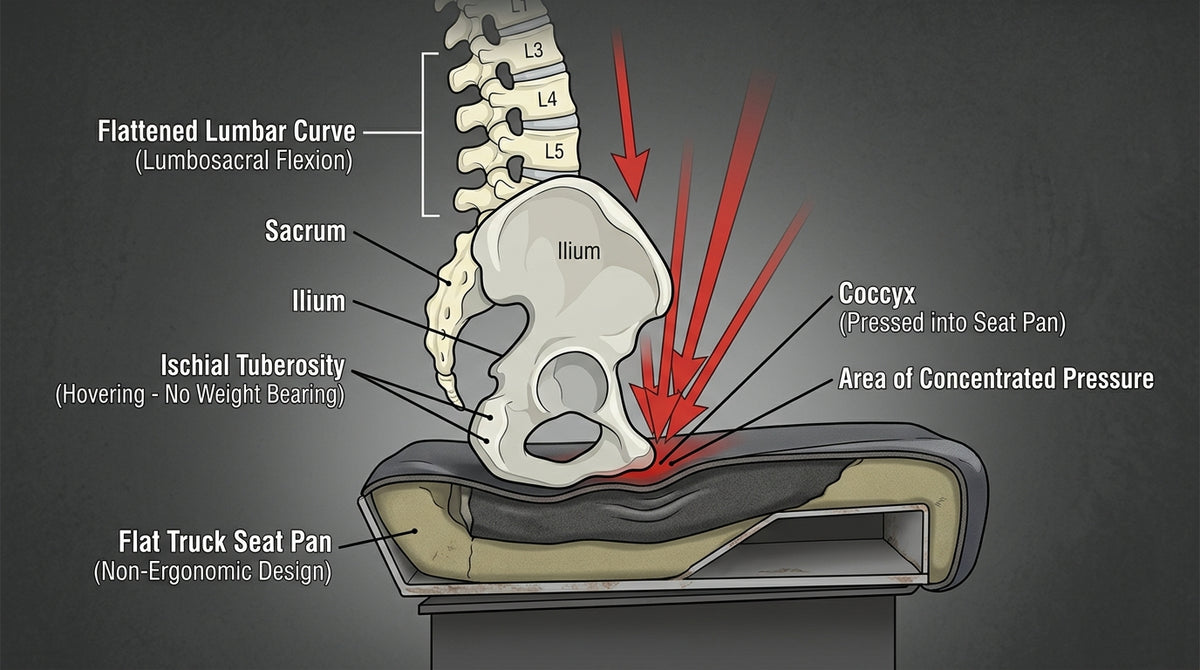
Your seat leaves a gap behind your lower back. Every seat does. Reach behind you right now and you'll find air where your spine curves in.
With nothing filling that gap, your pelvis rotates backward. Not dramatically. An inch of tilt over the first hour.
But that inch moves your weight. It rolls you off your sit bones — the two hard, flat contact points at the bottom of your pelvis, built to carry your body — and back onto your tailbone, which wasn't.
Do this right now. Sit on your hands. Feel those two hard points pressing into your palms? Those are your sit bones — the contact surfaces your pelvis was designed around. Every flat seat in every truck, every car, and every recliner in America ignores them. Every flat seat dumps the load behind them, straight onto the coccyx.
That's the part nobody explains. Your tailbone doesn't hurt because you sit. It hurts because the slump puts it in the firing line. The roll comes first. Everything else comes second.
higher stress on L4 and L5 in a slumped seated posture than standing — the two lowest movable vertebrae, where 90–95% of lumbar disc herniations occur.
MDPI Bioengineering, 2023 · finite-element modellingNearly three times the load. On the two vertebrae most likely to fail. On a stationary chair. Now add 2,500 miles a week of vibration on top of it.
The Sink
At the base of your spine is a knuckle of bone with essentially nothing over it. No muscle. No fat pad. Nothing to spread a load. Whatever is underneath it has to do that job — and whatever is underneath it is compressing.
Foam has a floor. Put 200-plus pounds on soft foam and it squashes toward that floor and stays there. Ten minutes in, it's a fraction of the thickness it had in the packaging. Past a point it's bottomed out — you're sitting on whatever is under it, through it.
Here's the part that matters if you've never bought a cushion in your life: your factory seat does this too.
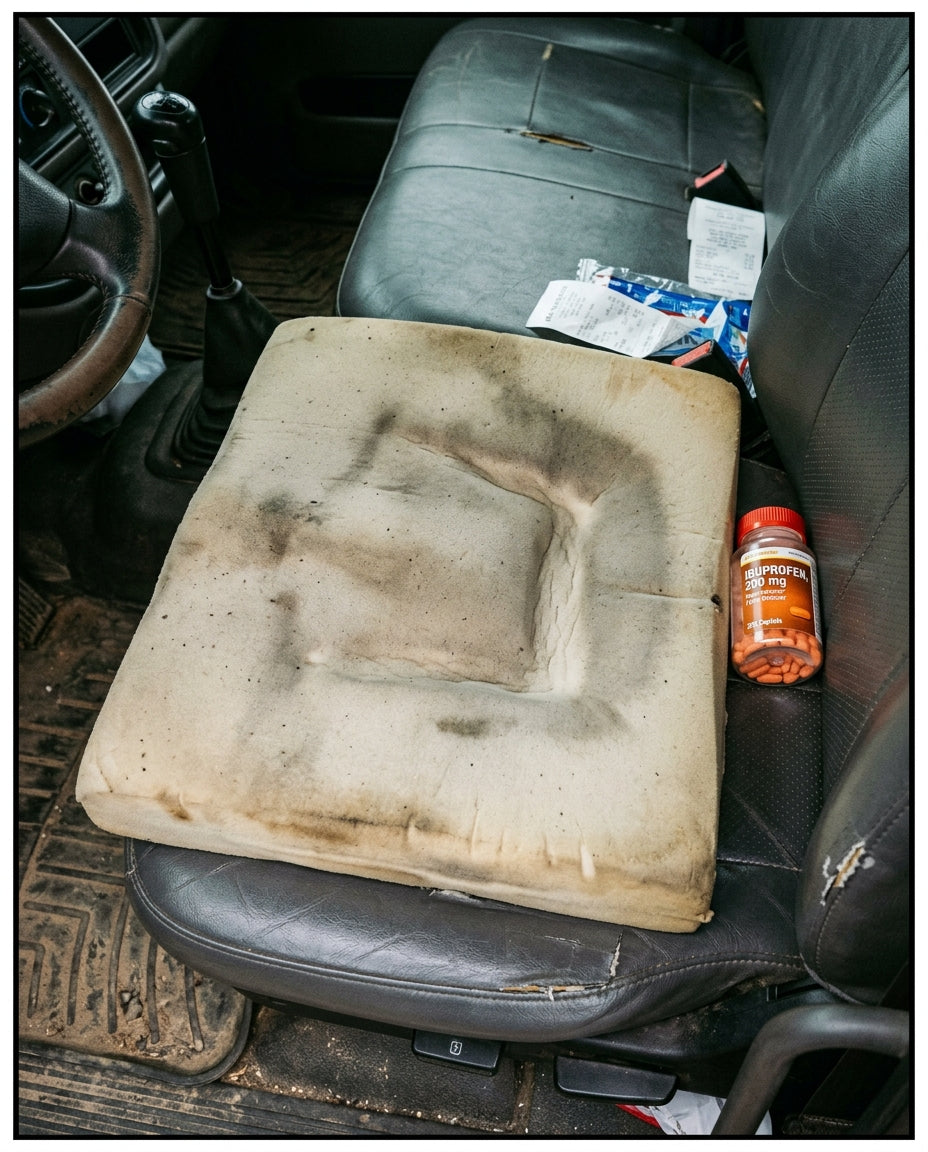
There is a dip in the seat pan of every truck with more than a hundred thousand miles on it. Dead center, back third, worn down through the fabric into a shallow bowl about the size of your fist. Years of one bone compressing the same square of foam until it stopped springing back.
The seat you're in right now has already bottomed out under your tailbone, and the factory is not coming to fix it.
And the cruel joke on anybody who has bought something — the softer it feels in the store, the faster it sinks. You bought softness. Softness is the thing that fails.
The Road
Now shake it. A steady weight is one thing. Eleven hours of vibration up through the frame is another. It turns steady pressure into thousands of small repeated impacts on one unprotected bone.
Every mile you drive, your body absorbs something called Whole-Body Vibration — WBV. Not the potholes. Not the bridge transition that launches your coffee into the dash. You brace for those.
WBV is the low, constant buzz — the vertical oscillation that travels up through the tires, through the frame, through the cab floor, through the seat pan, and into the base of your spine. Hour after hour. Mile after mile. Shift after shift.
You stop noticing it around mile 50. Your spine never does.
NIOSH — the National Institute for Occupational Safety and Health — classified WBV as a recognized occupational hazard for professional drivers. Here is the number that should stop every CDL holder who reads this:
of floor vibration is removed by a brand-new, factory-spec air-suspension truck seat. Oregon State researchers measured passive air seats at ~9% — and ~10% even with an aftermarket pad layered on top.
Oregon State University · independent measurement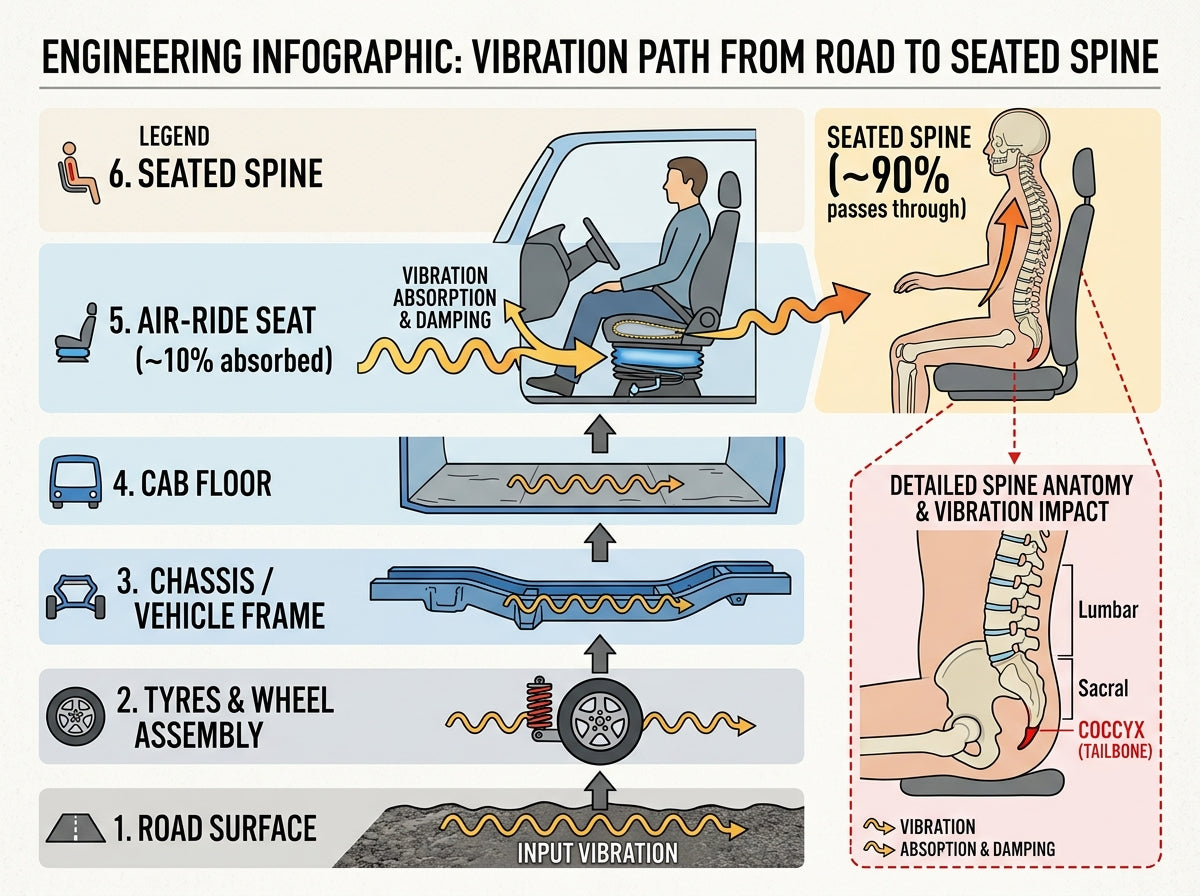
The expensive seat handles the craters. But the buzz — the constant, low-frequency grind that compresses your discs every second of every shift — rides straight through the suspension and into you.
A driver in a forum thread said it better than the researchers: your tailbone is bouncing on the road.
Roll. Sink. Road. Every mile, every day, for as long as you've been doing this.
Do the arithmetic on your own career for a second. Eleven hours a day, five days a week. That's about twenty-five hundred hours a year on one unpadded bone, in a machine that vibrates. Ten years in and you're at twenty-five thousand hours.
Nothing about you failed. You just did the same thing more times than a body was built for.
Ten seconds · in your own truck · right now
The palm test
Don't take anybody's word for any of this. Sit down. Put your palm flat on the seat — or on whatever you've got on the seat — an inch or two behind where your tailbone lands. Press down hard. Your weight, not a poke.
Can you feel the hard pan underneath?
If your hand gets through, so does your tailbone. Every mile. And now you know which of the three is already beating you.
Why everything you have tried has not worked
Look at Roll, Sink, Road — and you can see the problem with all of it.
| Blood pressure at the DOT physical | Certification |
|---|---|
| Under 140/90 | Full two-year card |
| 140–159 / 90–99 | One-year card |
| 160–179 / 100–109 | Three-month temporary |
| 180/110 or above | Disqualified until controlled |
Chronic pain raises the number. Chronic ibuprofen raises the number. The stress of wondering raises the number.
You are drugging the operator to compensate for the equipment. And the drug raises the number that costs you the 2-year card.
Every one of those fights one force and ignores the other two. Every one ends up in a pile with the others — on the cab floor, on the garage shelf, in the trash.
Where this goes if you leave it
This part does not need dressing up. These are the men who thought they had time.
42 years OTR — my back, my hips and knees all shot. Battle scars of trucking.
Second spine surgery. 40 year truck driver here.
I've been driving since 1998. I have 3 bulging lumbar discs.
Wish I knew this a year and a half ago. Now I'm getting back surgery.
Well, it's too late for me.
Public driver forum posts, paraphrased for context.
It is not an event. There is no day it happens to you.
It is an accumulation — which means the only number in this whole thing you actually control is how many more shifts you do it for.
That last man may be right about himself. He is almost certainly not right about you. It is just later than it was — and later is not the same word as too late.
You are going to sit in that seat tomorrow either way. That part is not optional. The only question is what is under you when you do.
What actually has to change
You have to hit all three. Miss one and the other two carry on without it.
Stop the roll
Something has to fill the gap behind your lower back and stay there — permanently, not for forty minutes. Which means it cannot be a separate object, because a separate object obeys gravity.
Stop the sink
The foam has to be dense enough that it doesn't bottom out at hour eleven, not just at minute one. Which means it will feel firmer than you expect on day one. That isn't a flaw. That is the mechanism.
Take the bone out of it
Not cushion the tailbone — remove the contact. A cutout, so it hangs over open air and touches nothing, while your weight moves out onto the sit bones that were built to carry it.
A cutout only works if the pelvis stops rolling and the foam stops sinking. Which is why it has to be one piece.
Seat and back as one body of foam. Not because it's tidier. Because the back panel is the thing that stops the roll, and the only way it holds position for eleven hours is if it's part of the object your own body weight is already pinning down.
So why doesn't everybody make it that way?
The answer is boring: money and boxes.
Moulding a seat and a lumbar panel as one continuous body takes one big tool and a lot more foam. Two separate pieces are cheaper to make, cheaper to ship, and they pack flat. So the category defaults to two pieces — and then it charges you for both.
Go price it out. The biggest-selling seat pad on the market is around fifty dollars, and the matching lumbar pillow is another forty. Ninety dollars, two objects, and they only cover one seat. Then the back one starts sliding down on day three and you're back where you started with a hole in your wallet.
Ninety dollars buys you two pieces for one seat. For about the same money you can have two complete cushions and cover two seats — and neither one can come apart, because there's nothing on either of them to come apart.
It's just cheaper for them to build the thing that fails, and easier to sell you the second half of it separately.
The one that does all three
 1
2
3
1
2
3
- 1 One bodySeat platform and lumbar panel are the same piece of foam. No seam, nothing to detach, nothing to fall on the floor.
- 2 The cutoutOpen air under the tailbone. Slide your hand in and nothing is there.
- 3 Sit-bone padsContoured and firm, so the weight lands on the two bones built to carry it.
Pressure-management research at Rancho Los Amigos — one of the most respected rehabilitation centres in the country — documented that cutout surfaces offload targeted pressure zones effectively. Pelvic health specialists have rated cutout designs above donuts for coccyx conditions for years (APTA Pelvic Health).
What has not existed until recently is a version built for the punishment of a Class 8 cab. Foam dense enough to hold shape under a 300 lb driver for 11 hours. A cutout rigid enough to stay open instead of collapsing. A base that grips vinyl through whole-body vibration. A back panel that is part of the cushion — not a separate piece on the floor.
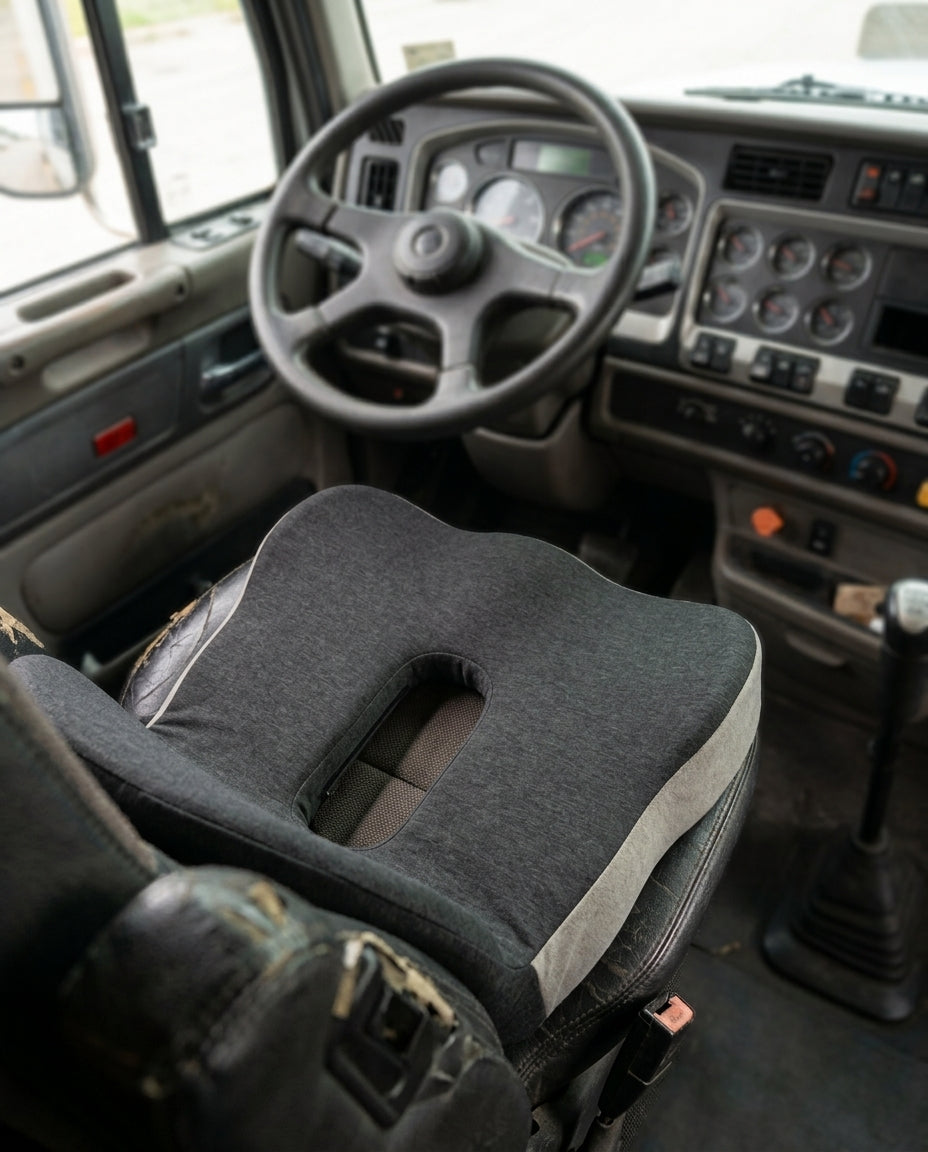
One company built all three into a single product. It is called the Nemira Orthopedic Cushion.
One continuous moulded L-shaped piece — that's the roll
The seat platform and the lumbar panel are the same body of foam. No seam, no strap, no clip, nothing that detaches. The back support physically cannot slide down behind you, because your own weight is sitting on the thing it's attached to.
Supportive-firm, high-density, high-ILD foam — that's the sink
Dense enough that you don't bottom out onto the seat underneath, at hour eleven and not just minute one.
An L-shaped cutout — that's the road
The tailbone hangs over open air and contacts nothing at all. Reach under. Slide your hand through the gap. Nothing is under the bone that has been carrying you for 200,000 miles — so there is no point of concentration for the vibration to hammer.
Roll, sink, road. All three, in one object, with nothing to come apart and nothing to adjust.
If you have ever crawled under a rig to find a weight distribution problem, this is the same logic. The load did not increase. The load moved. The overloaded axle is your tailbone. The fix is putting the weight where the chassis was designed to carry it.
The first ten seconds
Here's what nobody warns you about, and it's the reason this article exists. You feel it immediately.
Not in a week. Not once it's broken in. You lower yourself onto it and the pressure under your tailbone is simply gone — because the bone is now over a hole instead of over a seat. That is not something that has to develop. Either the bone is touching something or it isn't, and the second you sit down, it isn't.
That part is instant. Here's what comes after.
-
01
First day
Two minutes, once
It is firmer than you are expecting — that is the whole point, soft is what failed you — and it sits you up slightly. Drop your seat a notch and check your mirror line before you pull out. You never think about it again.
-
02
Day 2–3
The firmness disappears
You stop noticing it entirely. That is you recalibrating, not the foam giving way. The foam is not going anywhere — that is the point of it.
-
03
First week
You stop moving
This is the one that surprises people. It is not less discomfort. It is that you go a whole leg without hunting for a position, and you only notice afterwards that you did not do it once.
-
04
Week 2–3
The climb down
Hand on the wheel, straighten up slow — that two-stage move you have been doing so long you do not know you are doing it. One day you just get out of the truck.
Not the sitting. The getting out. That's what drivers report back on.
What changes when the tailbone stops taking the hit
The fuel island
Hour seven on the Arizona stretch of I-40. You pull in. Grab the handle. Swing down. Your boots hit the pavement and you just — walk. No lock-up. No shuffle. No leaning on the pump.
The berth
No throb at 2 a.m. You sleep the full 10 and wake up without a deficit.
The 800-mile run
The one you have been turning down because you cannot sit that long anymore. You take it. Dispatch notices. The premium freight comes back.
The DOT physical
You walk in without a week of dread. One fewer variable pushing the number. One fewer bottle in the medicine bag the examiner is going to notice.
Home time
You walk through the door and pick up your kid. You make it to the yard. You take the boat out. You are not on the living-room floor with an ice pack wondering how much longer you can do this.
Every seat. Not just one.
The rig. The pickup. The recliner. The ache does not follow you home because the fix followed you first.
“I had already dropped the seat, dumped the air and moved my wallet out of my back pocket — all the things that half-work. This is the first one that changed how I feel climbing down at the end of a fourteen. Bought a second so there is one in the truck and one in the recliner.” Daniel R. · OTR, 26 yearsReader offer Save up to $60 OFF on the 3-pack — cab, pickup, home$134.95 for three against $194.85 buying three singles. Free US shipping on two or more, and sixty days to send them back.Claim $60 OFF 60-day guarantee · free shipping on 2 or more
What passed — and what didn't
One-body L-core design
Seat and lumbar panel are one piece of foam. Nothing separates. Nothing falls behind the seat. You pick it up in one hand. No straps to thread, no clips, no lumbar height to fiddle with — and it can't be set up wrong because there's nothing to set.
Derek K. · long-haul, two previous cushions“The back half of the last set spent more time on the floor of the cab than behind me. This one is the same piece of foam I am sitting on, so there is nothing to fall down.”
L-shaped coccyx cutout
Tailbone contacts nothing. The gap stays open under a heavy driver because the foam is firm enough to hold its shape — not collapse into a hammock.
High-density, high-ILD memory foam
Density = lifespan (resists flattening). ILD = firmness (keeps sit bones from sinking through). Most cheap cushions fail on both. It will feel firmer than you expect on day one. That is the entire mechanism.
Marcus C. · owner-operator, 7 months“Forty thousand miles. Same shape it was in the box. My last one was a pancake by month two.”
Full non-slip rubber base
The entire underside. Not corner patches. Not rug tape. Grips vinyl, leather and cloth. In the seat when you climb back in.
Wes H. · route driver, in and out 30–40 times a day“Every cushion I have owned was half on the floor by lunch. This one has not moved once.”
Fits 17–18″ seats
Truck cab. Pickup. Office chair. Recliner. If you run a wide seat, or you're a big guy who fills the pan corner to corner, measure yours before you order. Thirty seconds with a tape measure.
Machine-washable cover
Knit fabric. Unzips. OEKO-TEX certified foam. Because you're going to sit on this eleven hours a day.
Questions drivers ask before they order
“I weigh 280. Will it bottom out like the last three?”
High-density, high-ILD foam — built for heavy drivers on long shifts. Marcus C. is seven months and 40,000 miles in at well over 200 lbs. The cutout stays open. The sit bones do not sink through. That is what “high ILD” means in practice. Run the palm test on it when it arrives — if your hand gets through to the seat underneath, send it back. It won't.
“Will it push me up too close to the ceiling?”
It adds some height. One driver: “I dropped my seat one notch and it was fine after that. Worth knowing before you order.” Most trucks have the adjustment. Two minutes, once.
“I have been burned. All cushions are the same.”
Every cushion you have bought put a softer layer between your tailbone and the seat. The coccyx still bore the weight — it just passed through softer material on the way down. This one removes the coccyx from the surface entirely. That is not a padding difference. It is a structural difference. Slide your hand into the gap and feel the distinction. And there are sixty days on top of it.
“Why three? Why not start with one?”
Because the roll and the sink don't clock out when you park. Count the seats you actually sit in on a working day: the rig — eleven hours. Whatever you drive when you're not working — call it an hour. And the chair you drop into when you get home and don't get out of until bed — call it three. That's fifteen hours a day of sitting, and one cushion covers eleven of them. Your recliner is not orthopaedic. Your pickup seat is a car seat. The bone doesn't know it's off the clock.
“Can I just carry one between seats?”
You won't. You'll do it twice, then it lives in the rig, and every hour you're not driving goes back to being unprotected. That's why most drivers who start with one end up ordering two more within a month. At $44.98 each in the 3-pack, the full set costs less than one gel grid that ends up on the floor.
“I'm a big guy. Will it be wide enough?”
17 to 18 inches — sits inside a truck seat pan without hanging over. If you fill your seat pan corner to corner, measure first. Thirty seconds with a tape measure. Better to check than send it back.
“What if it does not work for me?”
60 days. Any seat. 10,000 miles if you want. One email to return. Full refund. No explanations. You will know within the first week. You have eight.
What 1,286 drivers said
4.5 out of 5 stars, 1,286 verified reviews. Comfort opinions — nobody is saying “it cured my back.” Here is what they are saying:
“By hour four I was perched on the front edge with a folded jacket jammed behind my back. Five months in I have not thought about my tailbone once.”Bernadette S. · long-haul, 5 months
“The cutout means my tailbone isn't carrying anything anymore — the weight goes into my sit bones instead. First afternoon in months I didn't count down to 5 p.m.”Priya N. · long-haul, 11-hour shifts
“Eleven hour runs and my hip used to be screaming by hour seven. It sits in the cab all week and comes into the house on my days off.”Wes T. · long-haul, 4 months
“I stopped noticing my tailbone. That's the entire review.”Greg A. · 9 hours a day
Every seat. Not just one.
Drivers who order one come back for two more within a month. Here is why they do not wait.
Reader offer Save up to $60 OFF on the 3-pack — cab, pickup, home$134.95 for three against $194.85 buying three singles. Free US shipping on two or more, and sixty days to send them back.Claim $60 OFF 60-day guarantee · free shipping on 2 or more| Pack | Price | Per cushion | Shipping |
|---|---|---|---|
| 3-Pack — cab, pickup, home | $134.95 | $44.98 | Free |
| 2-Pack | $99.95 | $49.98 | Free |
| Single — start here to test | $64.95 | $64.95 | $4.95 |
Here's where it stops being close. One cushion is $64.95, plus $4.95 to ship it — covers the truck. Two is $99.95, shipping free: the second one costs you thirty-five dollars. Three is $134.95, shipping free: the third one is another thirty-five.
Now put that next to what the rest of the market charges. A seat pad from the biggest seller out there is around fifty dollars and the matching lumbar pillow is another forty. Ninety dollars for two pieces that cover one seat — and one of the two starts sliding down on day three.
For $99.95 you get two complete cushions, covering two seats, neither of which can come apart. Same money. Twice the seats. Nothing to slide.
Buy one now and add the other two later and you pay $169.85 for the same three cushions. Buy them one at a time and it's over two hundred. Buying them one at a time is the most expensive way to end up exactly where most drivers end up anyway.
The math that makes this obvious
| What you would spend instead | Annual cost |
|---|---|
| Truck-stop pads (rebuy monthly) | $240–$360 |
| The gel grid + rug tape + the mid-back it creates | $130+ |
| Aftermarket air-ride seat swap | $1,500–$3,200 |
| Weekly chiropractor | $3,100–$10,400 |
| Parking 2 hrs early — 130 lost miles/day × $0.65 | ~$21,000 |
| The Nemira 3-Pack | $134.95 — once |
Three cushions. Every seat. Less than a tank of diesel. And the only thing on that list you buy once.
60-Day Silent Tailbone Guarantee
Run it for 60 days in the seat you actually use. The cab. The pickup. The recliner. Put 10,000 miles on it.
If it is not what you expected, send one email. Ship it back. Refund applied when the cushion arrives. No subscription. No restocking fee. No phone tree. No explanations required.
Not “if it's defective.” If it isn't right for you. You will know within the first week whether it changes the way you climb down from the cab. You have eight.
Tomorrow morning you will climb into the same seat
The roads will not improve. The factory seat will not redesign itself. The air-ride will keep passing 90% of the road into the base of your spine.
Every mile on a flat seat pan is another mile with your full body weight on a bone the size of your thumb. Every day you wait is another day the chain has a place to start — the ache, the pills, the number, the card.
You cannot control the road. You cannot control the examiner. You cannot swap out a company seat.
The one variable you control is where your weight lands.
Suspend the tailbone. Ride on the sit bones. Cover every seat you sit in. And the next time you swing down at the fuel island — grab handle, boots on the pavement — find out what it feels like to just walk.

P.S.Run the palm test before you buy anything from anyone, including this. Palm flat on the seat, press hard, see if you get through to the pan. If you don't get through, you don't need this page.
P.P.S.If you've never used a cushion in your life and you're wondering whether any of this applies to you — it applies most to you. The men with a cushion are at least fighting one of the three forces. You've got a seat that bottomed out around year four and nothing between it and the bone.
P.P.P.S.If you've already had the surgery, or you're on the list for one — nobody is telling you this fixes that, and don't let anybody sell you that it does. What this page is telling you is the seat doesn't care what your back has already been through, and it's still eleven hours a day.
P.P.P.P.S.For the wife or the girlfriend reading this at midnight because he won't — don't argue with him. Put it in the truck. Say “run one day on it, for me.” The seat does the convincing, not you.
P.P.P.P.P.S.The offer in one line: $64.95 for one, $99.95 for two ($49.98 each), $134.95 for three ($44.98 each), free US shipping on two or more, sixty days to send it back if it isn't right.
The Nemira Orthopedic Cushion is a seating support product designed to redistribute seated body weight. It is not a medical device and is not intended to diagnose, treat, cure, or prevent any disease or medical condition. Individual comfort experiences vary. Statistics cited are from published occupational health research (NIOSH, Oregon State University, MDPI Bioengineering 2023, BMC Public Health, Rancho Los Amigos, FMCSA) and are referenced for educational context. FMCSA blood-pressure certification tiers are summarised from 49 CFR 391.41 and the Medical Examiner's Handbook. Driver quotes in the “Where This Goes” section are paraphrased from public forum posts for educational context. All product reviews are verified-purchase opinions about comfort and product experience from trynemira.com. Consult a healthcare professional for medical concerns.