

Occupational health · Owner-operator economics
Your Truck Seat Is Costing You $21,000 a Year. Here Is Exactly How the Chain Works.
800 mg of Vitamin I, Twice a Day, Just to Finish the Fourteen. What It's Doing to the Number on Your DOT Card.
Pain → Pills → Pressure → Card → Miles → Money. It Starts in the Seat.
Pain leads to pills. Pills push the number. The number shortens the card. The card costs you the miles. Every link traces back to one bone in one seat — and only the first link is still in your hands.

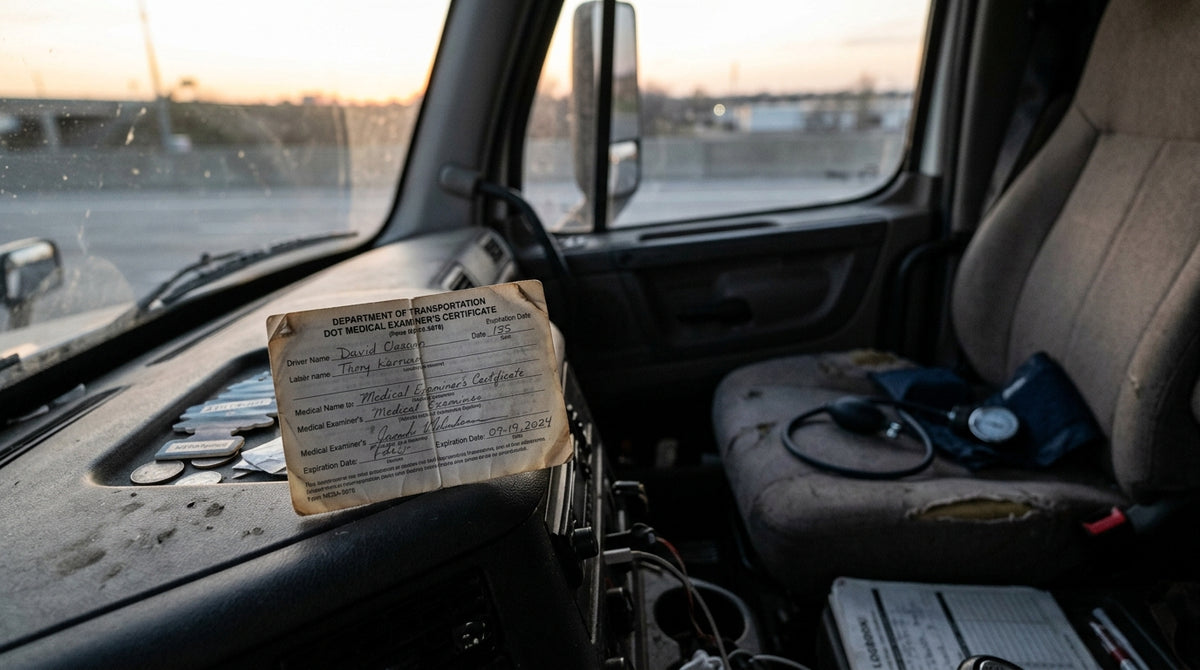
What this article establishes
- The chain has five links — the seat, the pills, the number, the card and the miles — and they run in that order, every shift.
- Every fix you have bought treats one link and leaves the other four running. Two of them make a later link worse.
- Only the first link is reachable. You cannot control the road, the examiner or the number. You can control what your weight lands on.
The fluorescent lights are doing that thing they do in every clinic — the flat white hum that turns everybody the same colour.
You're in the chair. The cuff is on your arm. The pump squeezes, holds, hisses down.
And you're doing what you always do in that chair: sitting still, breathing slow, trying not to think about the number — because you know that thinking about it pushes it up, and pushing it up is the last thing you need right now.
The examiner reads it off the gauge. Writes it on the form. Doesn't say anything yet.
You know what your back feels like. You know what you've been taking for it. And somewhere behind the fluorescent hum, you know those two things are connected to the number he just wrote down.
This article is about that connection.
Not about pain. Not about comfort. About the chain of dominoes that starts under your tailbone every shift, runs through the medicine cabinet, lands on the blood pressure cuff, and ends at the examiner's desk — where it becomes a number with a dollar sign in front of it.
Follow the money. It starts in the seat.
Does any of this show up in your numbers?
Before the chain — see how many of these you recognise.
Tap the ones you do
0of 6
And yes — you've already adjusted the seat
Set it so you're leaning back. Drop the front edge. Knees above the hips. Wallet out of the back pocket. Ride the air right. You've done all of it. Everybody has. It helps. It is not enough.
Because the seat adjustment addresses the posture — and the problem is the surface. The flat steel pan under the foam. The one part of the seat no adjustment can change.
But before the seat, let's follow the money.
The chain nobody talks about
Every chain has links. Here are yours, in order.
-
1
The seat
You sit on a flat pan for eleven hours. The factory foam bottomed out years ago. Your pelvis rolls back, your weight slides off the sit bones, and the full load drops onto one bone the size of your thumb — with no muscle and no fat pad over it — absorbing 2,500 miles a week of vibration.
-
2
The pills
By hour five the bottle comes out. 800 mg, twice a day — the same as a prescription dose. You are not medicating a disease. You are drugging the operator to compensate for the equipment.
-
3
The number
Chronic NSAID use raises blood pressure. So does chronic pain. So does the stress of wondering whether it will be higher this time. Three forces pushing the same number, and all three trace back to the seat.
-
4
The card
Nobody loses a CDL over one reading. But every link pushes the number the same way — and a shorter card means more visits, more monitoring, more anxiety feeding the next one. The chain tightens itself.
-
5
The miles
Long before the card gets shorter, the miles are already bleeding. Parking early. Turning down the long run. Dispatch remembers, and the premium freight goes to the driver who can still sit.
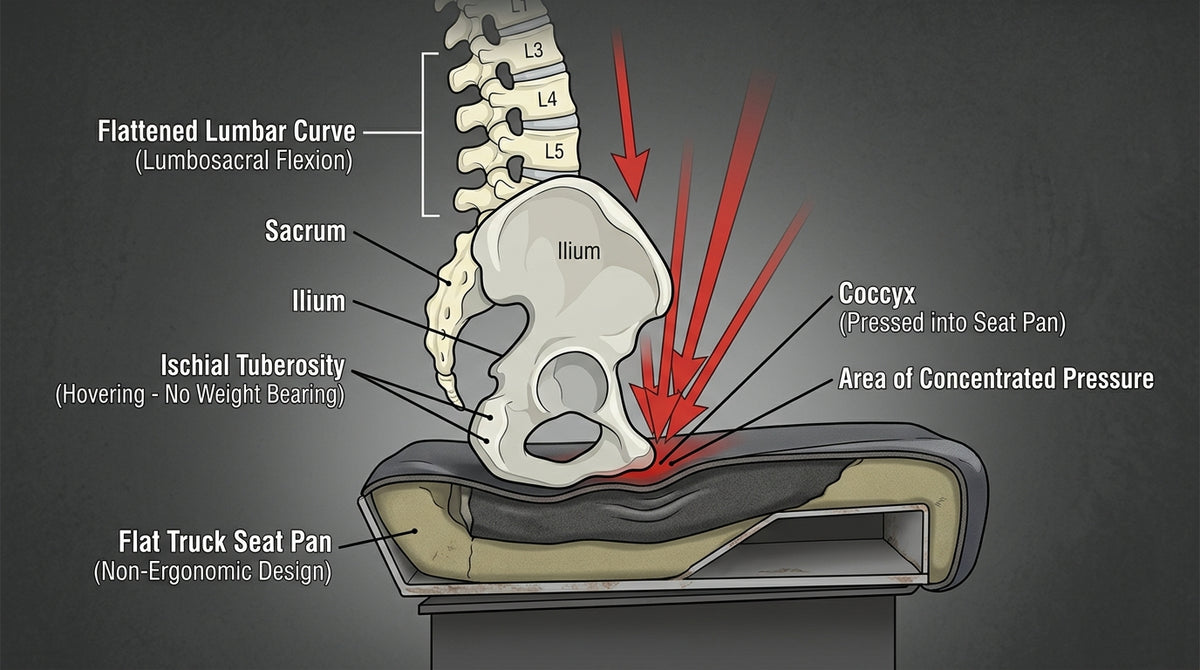
Link 1 — why the seat fails at the one job you assume it does
Your pelvis has two hard, flat contact points at the bottom — your sit bones. Sit on your hands and feel them pressing into your palms. That is where your weight is supposed to ride.
Every flat seat in every truck ignores both of them. Within 90 minutes the pelvis rolls backward, the lumbar curve flattens, and the weight slides off the sit bones and drops onto the coccyx.
higher stress on L4 and L5 in that slumped posture than standing — the two vertebrae where 90–95% of lumbar herniations occur.
MDPI Bioengineering, 2023of floor vibration is removed by a factory air-ride seat. The other 90% rides straight through the suspension, through the foam, and into the base of your spine.
NIOSH · Oregon State UniversityThat's Link 1. The seat loads the wrong bone. The air-ride barely matters. And it starts the chain.
Link 4 — what the number actually decides
| Blood pressure at the physical | Certification |
|---|---|
| Under 140/90 | Full two-year card |
| 140–159 / 90–99 | One-year card |
| 160–179 / 100–109 | Three-month temporary |
| 180/110 or above | Disqualified until controlled |
And that's before the examiner looks at the musculoskeletal line. 49 CFR 391.41(b)(7) qualifies a driver only if they have no orthopedic, muscular or neuromuscular condition that interferes with safe operation — left to the individual examiner's discretion, case by case.
The man reading the number on your arm also decides what to write on that line. And he watched you walk from the waiting room to the exam table.
Link 5 — the money, in one table
Owner-operators net an average of $64,524 a year (ATBS via Truckstop/Overdrive). Company drivers earn $0.50–$0.75 per mile on 2,200–2,800 miles a week.
| Where your income is going | Annual cost |
|---|---|
| Parking 2 hrs early — 130 miles/day × $0.65 | ~$21,000 |
| Turning down long runs — lost dispatch priority | $15,000+ |
| 2 unplanned off-days a month | ~$6,000 |
| Chiropractor, twice a month | $3,100–$10,400 |
| Truck-stop pads, rebought monthly | $240–$360 |
| Ibuprofen, daily | $150–$300 |
$21,000 a year in lost miles alone. A DOT card getting shorter. And the entire chain starts with one bone in one seat. A $45 cushion protects the asset generating $65,000 a year. That is the math.
The men who didn't break the chain
Before the fixes — look at what happens when the chain runs long enough.
42 years OTR — my back, my hips and knees all shot. Battle scars of trucking.
Second spine surgery. 40 year truck driver here.
I've been driving since 1998. I have 3 bulging lumbar discs.
Wish I knew this a year and a half ago. Now I'm getting back surgery.
Well, it's too late for me.
Public driver forum posts, paraphrased for context.
Every one of these men was once exactly where you are.
Same routes, same seat, same pills. Every one of them thought he had time.
This is not an event. There is no day the chain catches up. It is an accumulation — which means the only number you actually control is how many more shifts the chain has a place to start.
The question is not whether it is happening. It is how many links deep you are.
Why nothing you've tried has broken the chain
Every fix you've bought addresses one link and leaves the rest running.
That last one should stop you.
You are taking a pill to suppress the signal from Link 1, and the pill creates Link 3. The chain doesn't just continue — it feeds itself.
Where the chain can be broken
Follow it backward. The card gets shorter because the number climbs. The number climbs because of the pills, the pain and the stress. The pills exist because of the pain. The pain exists because of the seat.
You can't control the road
The vibration is physics.
You can't control the examiner
The number is the number.
You can't control the pills
They're a response to a stimulus.
The chain has one link you can reach. It's the first one.
Not the seat itself — you're not swapping a $3,000 air-ride into a company truck. But the surface your weight lands on. The thing that decides whether the tailbone takes the beating or the sit bones carry you the way they were built to.
Three things happen in that seat every shift — Roll, Sink, Road — and every one loads the wrong bone. To break Link 1 you have to hit all three. Miss one and the other two carry on.
Suspend the coccyx
An L-shaped cutout removes the tailbone from the surface entirely. It contacts nothing.
Transfer weight to the sit bones
The two hard points your pelvis was built around now carry the load.
Hold the pelvis upright
An integrated back panel prevents the backward roll, so the sit bones stay under you and the coccyx stays suspended.
One less reason the ache starts. One less reason the bottle comes out. One less variable pushing the number. That is not a medical claim. It is a link removed from the chain.
Ten seconds · in your own truck · right now
The palm test
Sit down. Put your palm flat on the seat, an inch behind where your tailbone lands. Press hard — your weight, not a poke.
Can you feel the hard pan underneath?
If your hand gets through, so does your tailbone. Every mile. The sink is already running — that's Link 1, right under you.
The product that breaks Link 1
One company built Roll, Sink and Road into a single piece of foam. It is called the Nemira Orthopedic Cushion.
 1
2
3
1
2
3
- 1 One bodySeat platform and lumbar panel are the same piece of foam. No seam, no strap, nothing to fall on the cab floor.
- 2 The cutoutOpen air under the tailbone. Reach under and feel it — the gap stays open because the foam is firm enough to hold its shape.
- 3 Sit-bone padsHigh-density, high-ILD foam. Dense enough to hold shape at hour eleven, firm enough that your sit bones don't sink through.
Full non-slip rubber base
The entire underside. Not corner patches. Not rug tape. Grips vinyl, leather and cloth.
Wes H. · route driver, 30–40 exits a day“Every cushion I have owned was half on the floor by lunch. This one has not moved once.”
Nothing to set up
No straps to thread, no clips, no lumbar height to fiddle with. You drop it in the seat and sit down.
Derek K. · long-haul, two previous cushions“The back half of the last set spent more time on the floor of the cab than behind me. This one is the same piece of foam I am sitting on, so there is nothing to fall down.”
It holds its shape
It will feel firmer than you expect on day one. That is the mechanism — soft is what failed you.
Marcus C. · owner-operator, 7 months“Forty thousand miles. Same shape it was in the box. My last one was a pancake by month two.”
17–18″ width
Fits most truck cabs, pickups and home chairs. If you run a wide seat, measure yours first — thirty seconds with a tape measure.
Machine-washable cover
Knit fabric, unzips completely. OEKO-TEX certified foam.
The first ten seconds
You lower yourself onto it and the pressure under your tailbone is simply gone — because the bone is now over a gap instead of over a seat. Either it's touching something or it isn't. The second you sit down, it isn't.
- 01
Day one
Firmer than you want
Drop your seat one notch and check your mirrors. Two minutes, once.
- 02
Day 2–3
The firmness disappears
That's you recalibrating, not the foam giving way.
- 03
First week
The bottle stays shut
You go a whole leg without shifting. No hip hunting, no counting exits. You only notice because you didn't do it — and the ibuprofen stays in the door pocket.
- 04
Week 2–3
You take the 800-mile run
The climb down stops being a two-stage move. The berth stops throbbing at 2 a.m. And the run you've been declining comes up on the board — and you take it. Dispatch notices.
“I had already dropped the seat, dumped the air and moved my wallet out of my back pocket — all the things that half-work. This is the first one that changed how I feel climbing down at the end of a fourteen.” Daniel R. · OTR, 26 years
Questions drivers ask
“I weigh 280. Will it bottom out?”
High-density, high-ILD foam, built for heavy drivers. Marcus C. is seven months and 40,000 miles in at well over 200 lbs and it is the same shape as the box. Run the palm test when it arrives — if your hand gets through to the seat, send it back. It won't.
“Will it push me up too high?”
Drop your seat one notch. One driver: “I dropped my seat one notch and it was fine after that.” Two minutes, once.
“I've been burned. All cushions are the same.”
Every cushion you've bought put a softer layer between your tailbone and the seat. The coccyx still bore the weight. This one removes it from the surface entirely. That's not a padding difference — it's a structural one. Slide your hand into the gap.
“Does a cushion actually affect the chain?”
Nobody is claiming a cushion lowers blood pressure or changes a DOT physical. What this page is telling you is that if you remove the first link — the bone that should not be carrying you — there is one less reason the ache starts, one less reason the bottle comes out, and one less variable pushing the number. That is a link you can remove.
“What if it doesn't work?”
60 days. Any seat. 10,000 miles. One email to return, full refund. You'll know within the first week.
What 1,286 drivers said
4.5 out of 5 stars, 1,286 verified reviews. Comfort opinions — nobody is saying it fixed their career.
“By hour four I was perched on the front edge with a folded jacket jammed behind my back. Five months in I have not thought about my tailbone once.”Bernadette S. · long-haul, 5 months
“The cutout means my tailbone isn't carrying anything anymore — the weight goes into my sit bones instead.”Priya N. · 11-hour shifts
“Dropped my seat one notch and it was fine after that. Six months in and it still hasn't gone flat. My last one was done in eight weeks.”John L. · long-haul, 6 months
“Bought one for the rig, then one for the pickup, then one for the recliner. Should have just bought the three-pack.”Tom B. · owner-operator
The arithmetic on three
The chain doesn't clock out when you park. Count the seats you sit in on a working day. The rig — eleven hours. The pickup — call it an hour. The recliner when you get home — call it three. That's fifteen hours of sitting, and one cushion covers eleven of them.
Your recliner is not orthopaedic. Your pickup seat is a car seat. The bone doesn't know it's off the clock. And don't tell yourself you'll carry one between them — you'll do it twice, then it lives in the rig.
Reader offer Save up to $60 OFF on the 3-pack — cab, pickup, home$134.95 for three against $194.85 buying three singles. Free US shipping on two or more, and sixty days to send them back.Claim $60 OFF 60-day guarantee · free shipping on 2 or more| Pack | Price | Per cushion | Shipping |
|---|---|---|---|
| 3-Pack — cab, pickup, home | $134.95 | $44.98 | Free |
| 2-Pack | $99.95 | $49.98 | Free |
| Single — start here to test | $64.95 | $64.95 | $4.95 |
One is $64.95 plus $4.95 shipping. Two is $99.95 — the second costs thirty-five dollars. Three is $134.95 — the third is another thirty-five. Buy one now and add two later and you pay $169.85. Buying them one at a time is the most expensive way to end up exactly where most drivers end up anyway.
Put this next to the chain
| The chain costs you | Annual |
|---|---|
| Parking 2 hrs early — 130 miles/day × $0.65 | ~$21,000 |
| Turning down long runs — lost dispatch priority | $15,000+ |
| Chiropractor, twice a month | $3,100–$10,400 |
| Ibuprofen and truck-stop pads | $400–$660 |
| The Nemira 3-Pack | $134.95 — once |
Three cushions. Every seat. Less than two chiropractor visits. Less than one day of parking early. And the only thing on that list you buy once.
60-Day Silent Tailbone Guarantee
Run it for 60 days in the seat you actually use. The cab. The pickup. The recliner. Put 10,000 miles on it.
If it is not what you expected, send one email. Ship it back. Refund applied when the cushion arrives. No subscription, no restocking fee, no phone tree, no explanations required.
Not “if it's defective.” If it isn't right for you.
One link
That's all this is. The chain has five links. You can reach one of them — the first one. The seat.
You are going to sit in that seat tomorrow. The same hours, the same roads, the same vibration. The pills will be in the door pocket. The physical will be on the calendar.
But picture this: the 800-mile run comes up on the board, and you take it. The fuel island at hour seven, and you swing down without the shuffle. The next physical, and you sit in that chair without running the number in your head for two weeks beforehand.
The one variable in the chain you control is where your weight lands. Break the first link. See what happens to the rest.

P.S.Run this test before you buy anything from anyone, including this. Palm flat on the seat, an inch behind the tailbone, press hard. If you feel the pan — the sink is running. That's Link 1 right under you.
P.P.S.If you run numbers for a living — and every owner-operator does — do the arithmetic on parking early. 130 miles a day at $0.65. Multiply by your working days. Then look at $134.95 for three cushions.
P.P.P.S.For the driver two weeks out from the physical who just wants the number to behave — nobody is telling you a cushion changes the reading on the cuff. Only that there is one fewer reason the ache starts the chain.
P.P.P.P.S.For the wife reading this because he won't — put it in the truck. Don't argue. Say “one day.” The seat does the convincing.
P.P.P.P.P.S.The offer in one line: $64.95 for one, $99.95 for two, $134.95 for three, free US shipping on two or more, sixty days to send it back.
The Nemira Orthopedic Cushion is a seating support product designed to redistribute seated body weight. It is not a medical device and is not intended to diagnose, treat, cure or prevent any disease or medical condition. It does not lower blood pressure, replace medication, or affect the outcome of a DOT physical. Individual comfort experiences vary. Income and cost figures are based on published industry data (ATBS via Truckstop/Overdrive, BLS) and example calculations for educational context; actual earnings vary by carrier, lane and experience. FMCSA blood-pressure certification tiers are summarised from 49 CFR 391.41 and the Medical Examiner's Handbook; musculoskeletal qualification is at the certified medical examiner's discretion. NIOSH WBV classification and the ~10% seat-absorption figure are from published occupational health research, and describe seats, not this product. Driver quotes in “The men who didn't break the chain” are paraphrased from public forum posts for educational context. All product reviews are verified-purchase opinions about comfort and product experience from trynemira.com. Consult a healthcare professional for medical concerns.