

Occupational health · Seated load mechanics
There’s Nothing Wrong with Your Back. There’s Something Wrong with What You’re Sitting On.
The Mechanical Reason Your Tailbone Burns by Hour Four — and Why Nothing You've Tried Has Changed It
You Inspect 15 Points on Your Rig Every Morning. The Surface Under Your Tailbone Isn't One of Them.
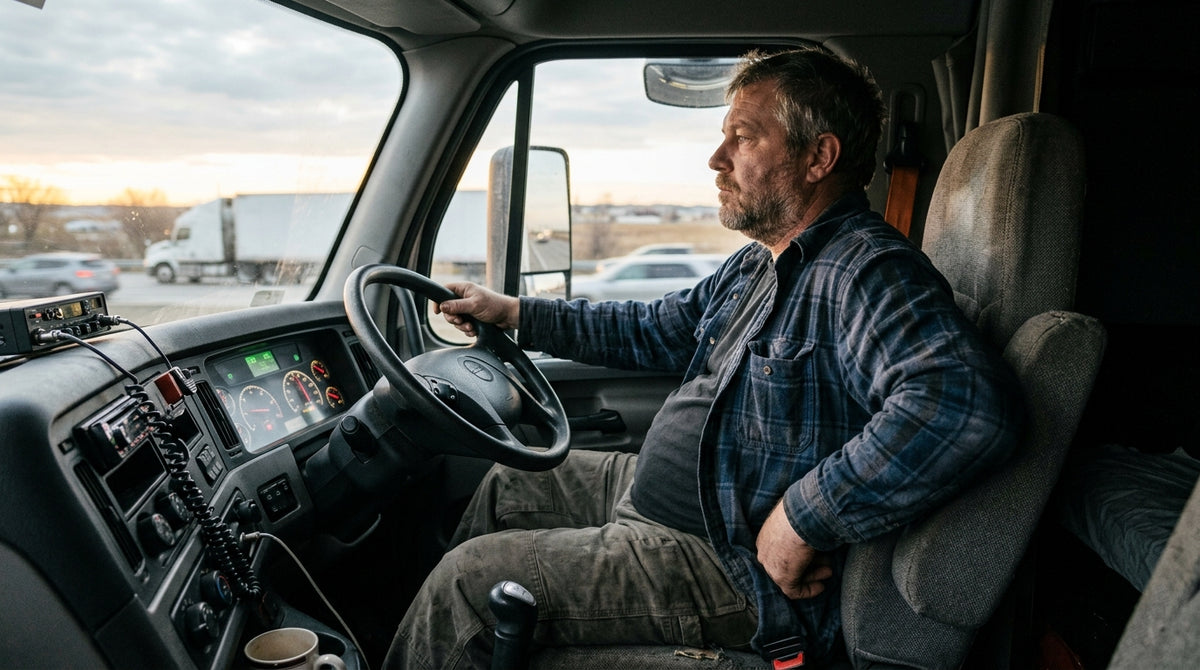
Hour four, the burn. Hour six, the shifting. Hour eight, the countdown. It is not age, it is not the road and it is not bad luck — it is mechanical, and it has a cause you can name.

What this article establishes
- The pattern you have is mechanical, not medical. It has a cause you can name, in a place you can reach.
- Three forces act on one bone, every shift, in a fixed order — and every fix on the market addresses one of them.
- Nothing about you has failed. You did the same thing more times than a body was built for, on a surface engineered for cost.
You know what it feels like. You've known for years.
- 04
Hour four
The dull burn starts
At the base of the spine. Not sharp enough to stop for. Just there — a heat that starts at the tailbone and spreads into the hips.
- 06
Hour six
The shifting starts
One hip. The other. You lean forward. You push off the armrest. You reposition for the twentieth time and none of the positions is the right one.
- 08
Hour eight
The countdown
Exits. Rest stops. Any reason to stand up for thirty seconds.
- 11
The climb down
A two-stage move nobody taught you
Hand on the wheel. Straighten up slow. Hope the hips agree to hinge. Then the stiff, guarded walk across the lot that every driver over forty knows — and every driver under forty is starting to learn.
You are not imagining this and you are not exaggerating it. Roughly 55% of truck drivers report low-back issues over the course of a year, and close to 62% have a musculoskeletal disorder of some kind.
BMC Public Health — systematic review and meta-analysis of musculoskeletal disorders in professional drivers.
But here is the part nobody has told you.
There is nothing wrong with your back. There is something wrong with what you are sitting on.
It's not what you think
Four explanations you have probably already given yourself. Here is why each one is wrong.
-
It's not age
Twenty-five-year-olds in their first year OTR post about tailbone pain. Age makes it worse. Age does not cause it.
-
It's not the road
You feel it on smooth interstate and on rough secondary. You feel it in the truck and in the recliner. The road changes the intensity. It does not cause it.
-
It's not your weight
Light drivers get it too. A 175 lb driver on a flat seat loads the same bone in the same position as a 280 lb driver. Weight changes the magnitude. It does not cause it.
-
It's not bad luck
Six in ten professional drivers have a musculoskeletal disorder. That is not a coincidence. That is an occupational pattern with a mechanical explanation.
-
It is the surface
The surface you have been sitting on for 2,500 miles a week. That is the variable that is actually different about your job — and it is the one nobody inspects.
The ten-minute explanation nobody gave you
A physical therapist can explain this entire mechanism in about ten minutes. Nobody has — not a doctor, not the DOT examiner, not the man who sold you the seat. Here it is.
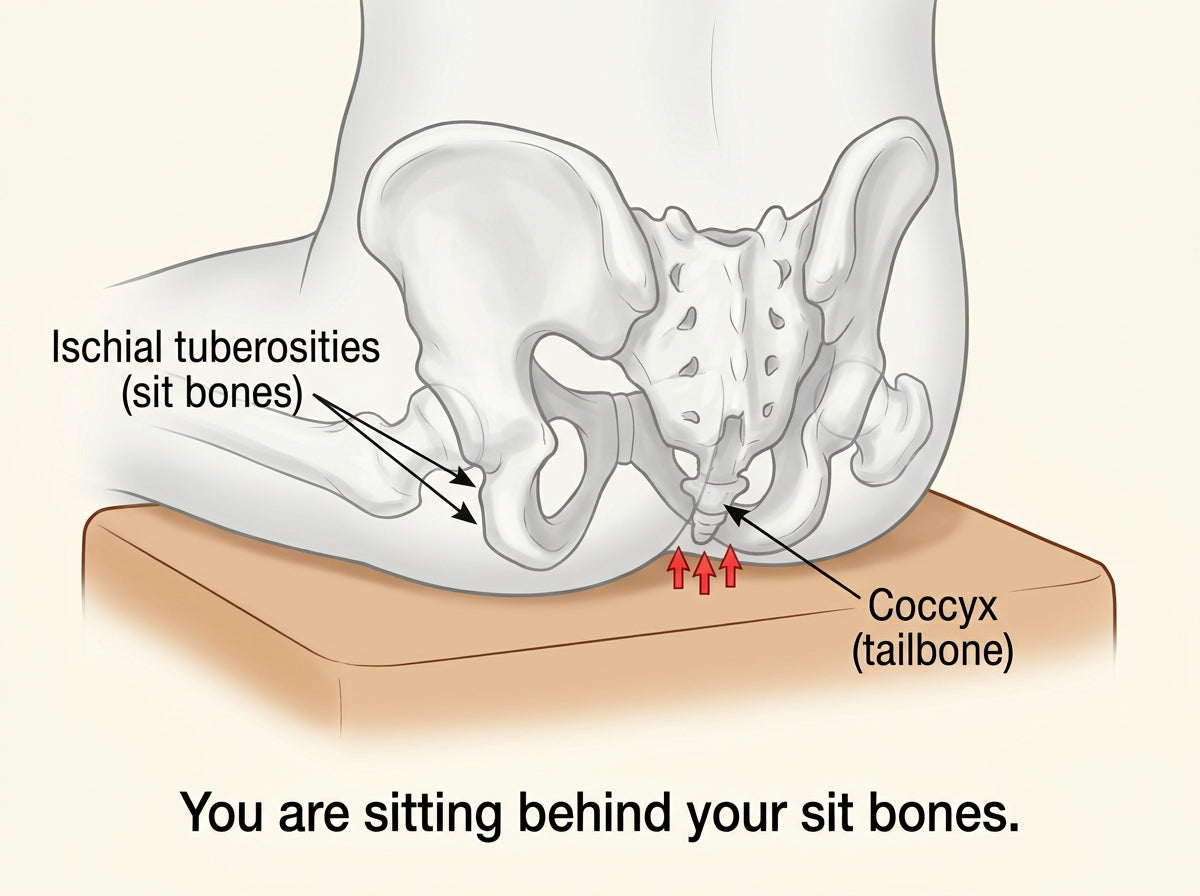
Sit on your hands. Feel those two hard points pressing into your palms?
Those are your sit bones — the ischial tuberosities. Two flat, hard contact surfaces at the bottom of the pelvis, and the load-bearing foundation your whole skeleton is built around. That is where your weight is supposed to ride. On every seat, in every vehicle, for every hour.
Here is what actually happens. Within ninety minutes on a flat seat the hip flexors shorten, the pelvis rolls backward, and the lumbar curve — the natural arch in your lower back — flattens.
When that arch goes, your weight slides off the sit bones and drops onto the bone directly behind them: the coccyx. A curved bone at the very base of the spine. The size of your thumb. No muscle over it, no fat pad protecting it, built for ligament attachment rather than for carrying load.
That bone has been carrying you for years. It was never built for the job.
Three forces — every shift — in this order
-
1
The Roll
The pelvis tilts backward and the weight slides off the sit bones onto the coccyx. Every flat seat, within ninety minutes, regardless of price, brand or adjustment. And you have already adjusted it — leaned it back, dropped the front edge, wallet out of the back pocket, rode the air right. All of it helps. All of it delays the roll. None of it stops it.
-
2
The Sink
The foam under the coccyx bottoms out. That dip in your seat pan — the one you have looked at for years without thinking about it — is the sink. Years of one bone compressing the same square of foam until it stopped coming back. Soft foam fails first, which is why the softer the pad you put on top, the faster it goes.
-
3
The Road
Whole-body vibration turns constant pressure into thousands of small impacts on an unprotected bone. NIOSH classifies it as an occupational hazard for professional drivers. A factory air-ride seat removes approximately 10% of floor vibration. The other 90% rides straight through.
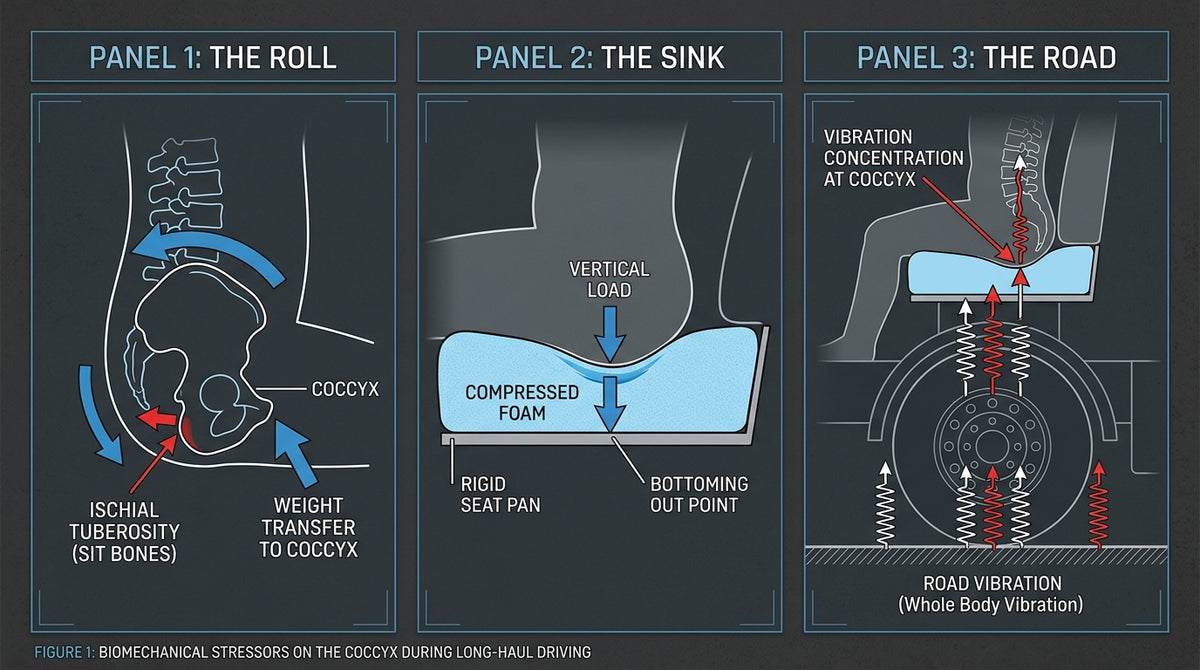
What those three forces do to the spine
Engineers modelled what the rolled-back posture does to the lowest two vertebrae.
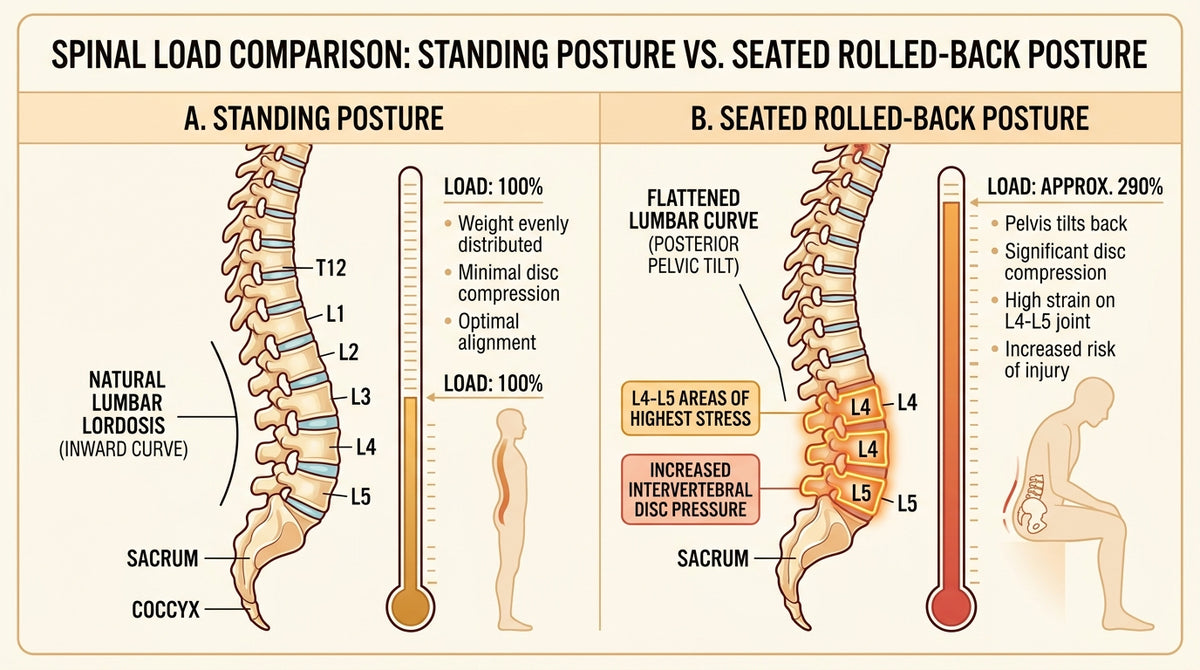
The stress on L4 and L5 compared with standing — the two levels where 90–95% of disc herniations occur. Nearly three times the load. On a stationary chair, before you add 2,500 miles a week of vibration.
MDPI Bioengineering, 2023 — finite-element modelling of lumbar load by posture.Nothing about you has failed. You did the same thing more times than a body was built for — on a seat engineered for cost, not for the skeleton sitting on top of it.
The pre-trip you never do
You inspect fifteen points on the rig every morning. Tyres, brakes, lights, fluids, coupling, frame. You do it because a missed defect becomes a failure on the road.
The surface between your tailbone and 2,500 miles of vibration is not on that list. Nobody put it there. And it failed quietly — not with a crack or a leak, but with a dip in the foam you looked at every day and never questioned.
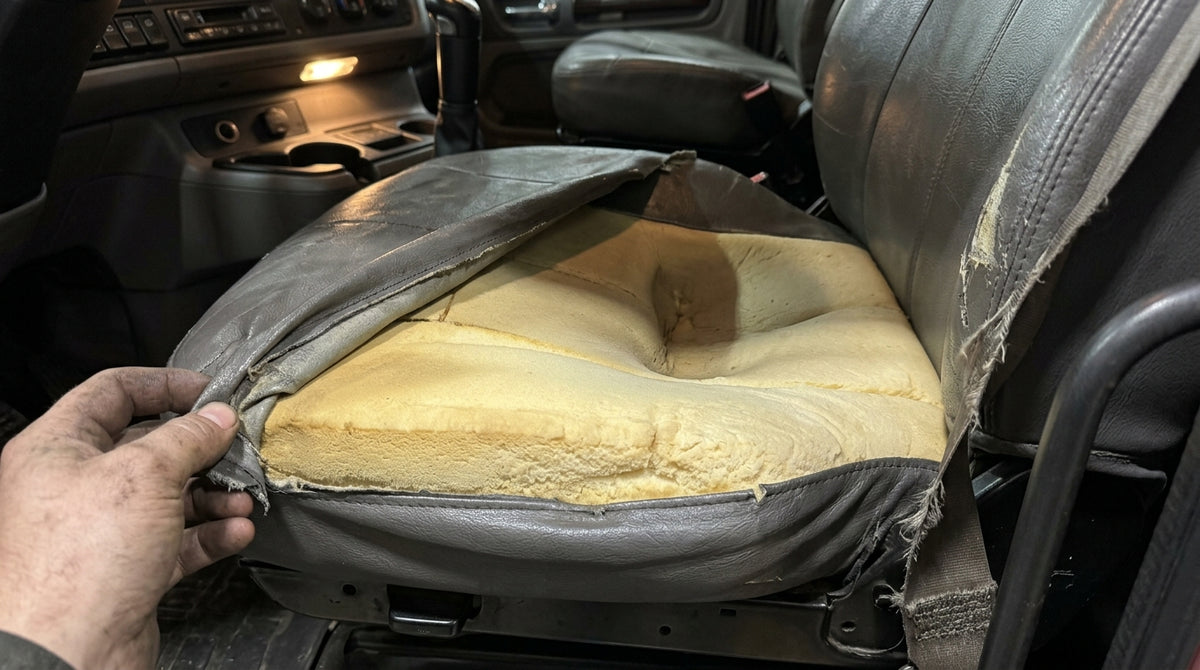
Ten seconds · in your own truck · right now
The palm test
Go to your truck. Sit down. Palm flat on the seat, one inch behind where your tailbone sits. Press hard — your full weight, not a poke.
Feel the pan? The hard surface through the foam?
If your hand gets through to it, so does your tailbone. Every mile, every shift. The seat stopped doing its job years ago — you just never had a reason to check.
Why nothing you've tried has changed it
Every fix on the market addresses one of the three forces and lets the other two run.
| What you tried | What it addresses | What it misses |
|---|---|---|
| Foam pad — $22 | The sink, for three weeks | Roll, road. Then the sink too. |
| Gel grid — $130 | Contact pressure | Roll. Creates mid-back strain. Slides out. |
| Two-piece set — $40–$80 | The roll, for about forty minutes | Sink, road. Then the roll, once the back half falls. |
| Ibuprofen | The signal | Nothing structural. Pushes the number. |
| Chiropractor — $75+ a visit | The result of the last twenty shifts | The next shift. |
Every one of these fights one force. You have to hit all three at once. Miss one and the other two carry on.
What would have to change
Three things — at the same time, in the same seat.
The coccyx comes off the surface
Not cushioned. Not softened. Suspended — the bone sits over a gap and contacts nothing.
The weight transfers to the sit bones
The two hard points your pelvis was built around take the load.
The pelvis stays upright
An integrated back panel holds it there — one piece, attached to the seat surface, so it cannot slide down.
One design hits all three.
The product
It is called the Nemira Orthopedic Cushion. One piece. L-shaped cutout. High-density foam. Full rubber base.
 1
2
3
1
2
3
- 1 Integrated back panel — stops the rollSeat and back panel are one piece of foam. Nothing separates, nothing ends up behind the seat, because your own weight sits on the thing it is attached to.
- 2 L-shaped cutout — the coccyx contacts nothingReach under and feel it: your whole hand fits, daylight on the other side. The gap holds open under a heavy driver because the foam is dense enough to keep its shape rather than collapse into a hammock.
- 3 Sit-bone pads — the weight transfers hereHigh-density, high-ILD foam. Firm, dense, and still holding shape at hour eleven.
Full non-slip rubber base
The entire underside, not corner patches. Grips vinyl, leather and cloth.
Wes H. · 30–40 exits a day“Every cushion I have owned was half on the floor by lunch. This one has not moved once.”
Nothing to set up
No straps, no clips, no lumbar height to fiddle with. Drop it in the seat and sit down.
Derek K. · long-haul, two previous cushions“The back half of the last set spent more time on the floor of the cab than behind me. This one is the same piece of foam I am sitting on, so there is nothing to fall down.”
It holds its shape
Firm on day one by design — soft is the failure mode, not the feature.
Marcus C. · owner-operator, 7 months, 40,000 miles“Same shape it was in the box. My last one was a pancake by month two.”
17–18″ wide
Sits inside a truck seat pan without hanging over. If you fill yours corner to corner, measure first.
Machine-washable cover
Knit fabric, unzips completely. OEKO-TEX certified foam.
The first ten seconds
You sit down and the pressure under your tailbone is gone — because the bone is now over a gap. Either it is touching something or it isn't, and the second you sit down, it isn't.
- 01
Day one
Firmer than you expect
That is the point — soft is what failed you. Drop your seat one notch and check your mirrors. Two minutes, once.
- 02
First week
A full leg without shifting
No hip hunting. No counting exits. The ibuprofen bottle stays closed.
- 03
Week three
The climb down changes
No two-stage move. No stiffness. You just get out of the truck.
“I stopped noticing my tailbone. That's the entire review.”Greg A. · 9 hours a day
“By hour four I was perched on the front edge with a folded jacket jammed behind my back. Five months in I have not thought about my tailbone once.”Bernadette S. · long-haul, 5 months
4.5 out of 5 stars across 1,286 verified reviews — comfort opinions, from drivers.
The 3-pack — every seat, not just the cab
The rig, eleven hours. The pickup, an hour. The recliner, three. That is fifteen hours a day on a bone that does not clock out when you park.
Don't tell yourself you'll carry one between them. You won't.
Reader offer Save up to $60 OFF on the 3-pack — cab, pickup, home$134.95 for three against $194.85 buying three singles. Free US shipping on two or more, and sixty days to send them back.Claim $60 OFF 60-day guarantee · free shipping on 2 or more| Pack | Price | Per cushion | Shipping |
|---|---|---|---|
| 3-Pack — cab, pickup, home | $134.95 | $44.98 | Free |
| 2-Pack | $99.95 | $49.98 | Free |
| Single — start here to test | $64.95 | $64.95 | $4.95 |
One is $64.95 plus $4.95 shipping. Two is $99.95 — the second costs thirty-five dollars. Three is $134.95 — the third is another thirty-five. Buy one now and add two later and you pay $169.85. Buying them one at a time is the most expensive way to end up exactly where most drivers end up anyway.
What you're spending now against the fix
| Current spend | Annual |
|---|---|
| Parking 2 hrs early — 130 miles/day × $0.65 | ~$21,000 |
| Chiropractor, twice a month | $1,800–$4,800 |
| Foam pads, rebought monthly | $240–$360 |
| Ibuprofen, daily | $150–$300 |
| The gel grid — lasted a week | $130 |
| The Nemira 3-Pack | $134.95 — once |
Less than two chiropractor visits. The only thing on the list you buy once — and the only thing that changes which bone carries you.
60-Day Silent Tailbone Guarantee
Run it for 60 days. Any seat. 10,000 miles. If it isn't right for you, send one email, ship it back, full refund.
Not “if it's defective.” If it isn't right. You will know within the first ten seconds whether the pressure is gone. You have eight weeks.
The fix was mechanical
There is nothing wrong with your back. There is something wrong with what you have been sitting on.
Three forces. One bone. And a seat engineered for cost rather than for the skeleton on top of it.
The fix is mechanical too. Take the bone off the surface. Transfer the weight to the sit bones. Hold the pelvis upright. One piece of foam that does what the seat doesn't.

P.S.Run the palm test. Sit down, palm flat an inch behind the tailbone, press hard. If you feel the pan, the sink is already running — and that is the seat failing, not your back.
P.P.S.If you have already been through the chiropractor and a pile of foam pads and concluded that nothing works — it is not that nothing works. It is that everything you tried fights one force. The cutout, the integrated back panel and the dense foam hit all three. Sixty days to prove it.
P.P.P.S.The offer in one line: $64.95 for one, $99.95 for two, $134.95 for three, free US shipping on two or more, sixty days to send it back if it isn't right.
The Nemira Orthopedic Cushion is a seating support product designed to redistribute seated body weight. It is not a medical device and is not intended to diagnose, treat, cure or prevent any disease or medical condition. Nothing on this page is a diagnosis or medical advice — it describes the mechanics of seated load in general terms, not your individual situation, and “there is nothing wrong with your back” is a statement about seating mechanics rather than an assessment of any reader. Individual comfort experiences vary. Musculoskeletal prevalence figures are from BMC Public Health systematic reviews; spinal-stress figures are from finite-element modelling published in MDPI Bioengineering (2023); the whole-body-vibration classification and the ~10% air-ride absorption estimate are from NIOSH occupational-health research and describe seats, not this product. Income and cost figures are example calculations for educational context; actual earnings vary by carrier, lane and experience. All product reviews are verified-purchase opinions about comfort and product experience from trynemira.com. Consult a healthcare professional for medical concerns.