

First person · A buyer’s account
I researched for four days. This is what I bought him.
Here's what my husband said the first day he used it.
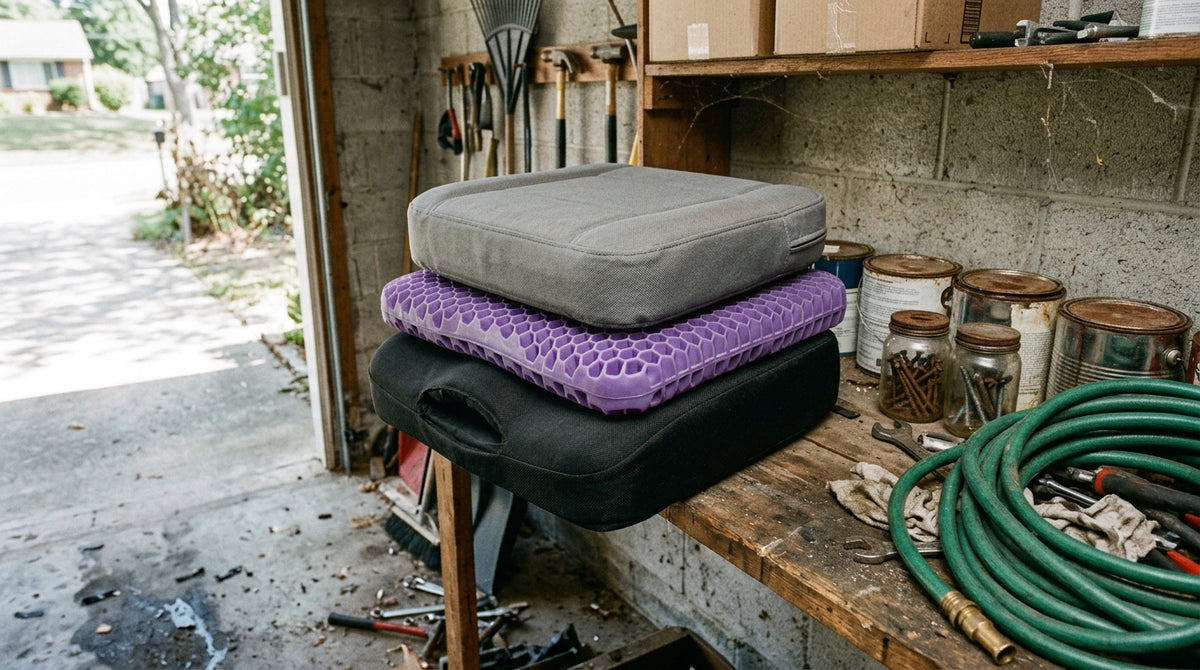
Every cushion I bought him ended up in the garage. Except this one.
Three cushions in the garage, eight months of chiropractic and a $3,100 seat I nearly bought. What finally worked cost $65 — and it wasn’t a better material, it was a different shape.

What this account covers
- $3,203 spent on things that didn't hold. Three cushions, eight months of chiropractic, and the $3,100 seat I nearly bought.
- Every one of them was the wrong shape, not the wrong brand. A flat surface is a flat surface, whatever it's made of.
- The fix was three things at once — and the one that mattered was an absence, not a material.
You're reading this because he never would.
He's not going to research seat cushions. He's not going to compare brands. He's not going to read reviews at midnight with a phone propped on his pillow, trying to work out which foam holds up after six weeks.
That's your job. It's always been your job. He drives. You fix everything else.
I know, because I was you two years ago.
My husband drives a truck for a living. He's the kind of man who clocks in, runs his hours, comes home, eats dinner standing at the kitchen counter because sitting down hurts, and goes to bed so he can do it again in the morning.
He does not complain. He says the seat is fine. He also says his back is fine. He also says four ibuprofen before every shift is fine.
You know better. Because you're the one watching.
How many of these have you watched?
Not what he says. What you've seen.
Tap the ones you've seen
0of 8
He's fifty-three. He shouldn't be moving like that — and not always. Not in the morning. But at six in the evening, when he's been in that seat for eleven hours and he's standing in the driveway waiting for something to release before he can walk to the door.
And his company is not going to fix it. He doesn't own the truck. He doesn't choose the seat. He put in a maintenance request eight months ago. Then another. "We'll get to it." There are two hundred trucks in that fleet and a worn seat doesn't move freight.
He can't swap trucks. He can't install a new seat. And he can't keep asking, because in this industry asking is a signal — it says I'm a problem — and that conversation ends careers.
So he sits in the seat they gave him. And takes the ibuprofen. And doesn't complain.
Here's what I need to tell you before you spend another dollar. I've been where you are. I bought the cushions. I booked the chiropractor. I researched the three-thousand-dollar seat at midnight while he slept next to me.
I made every mistake there is. It cost me $3,203. And the thing that actually worked cost $65.
Everything I bought before this
Three cushions, sixteen appointments, and one seat I nearly put on a credit card. Here's the receipt.
-
01
Memory foam from the truck stop

Soft when he squeezed it in the shop. Felt good the first week. By week three the centre had compressed to nothing — his full weight on the same square for eleven hours a day, and the foam didn't stand a chance.
The part under his tailbone went flat first. Then the bone was back on the seat pan with a dead piece of foam in between.
VerdictSofter for twenty-one days. It never changed which bone was carrying him.
-
02
The gel grid from Amazon

The honeycomb one everybody runs ads for. The egg test. The blue squares. Better than the foam, genuinely — it held its shape about four times longer.
But it slid on the truck seat every time he braked. And there was nothing behind his lower back, so he'd slump by hour two and the tailbone would drop straight back down onto the gel. Different material. Same bone on a surface.
VerdictA better material under the same bone, sliding out from under him twenty times a day.
-
03
The "trucker-rated" pad

From a brand that sponsors half the channels he watches. Thick. Heavy. Looked serious. All the marketing was long-haul drivers. I thought: this is the one.
Six weeks, then the centre pancaked. The edges were still fine. The corners were firm. The one square inch that mattered had compressed into a valley.
Verdict$150 to learn that thickness is not density, and neither one is shape.
-
04
The chiropractor

She was more honest than she had to be. Four months in, she looked at him and said it plainly.
His chiropractor, month four“I can adjust you. But if you're sitting on the same flat surface tomorrow for eleven hours, I'm resetting the clock. You come in, I fix it, the seat undoes it. We can do this for ten years, or we can deal with what's on that seat.”
She was right. We kept going another four months anyway, because two good days a week is two more than none.
Verdict$2,960 to have the same damage undone sixteen times by the same seat.
-
05
The $3,100 air-ride seat

This is the one I almost bought. I priced it. I watched the reviews. He saw the listing and his face changed for the first time in months. We'd have found the money — that's what a tax return is for.
Then I read the owner-operators who'd already bought one. Enough of them were saying the same thing he says about his factory seat: the air-ride handles the bumps, and the tailbone still hurts after eight hours.
Because air-ride absorbs road shock. It smooths vibration. All true. But the surface his tailbone sits on is still flat. It's a three-thousand-dollar flat surface.
I closed the laptop and felt sick — because if a $3,000 seat wasn't the answer, what was?
VerdictThe most expensive version of exactly the same problem. I came within one click.


Spent before I understood the problem. Plus $3,100 I came within a click of spending on a smoother-riding version of it.
One household. Two years. Three cushions still in the garage.Here's what I didn't understand. I wasn't buying bad cushions. I was buying the wrong shape.
Every one of them was flat. And it does not matter what a flat surface is made of — foam, gel, honeycomb, memory foam — because the tailbone is a bone, and bone is harder than every cushion material on the market. Under sustained weight the bone pushes through the material, the material compresses, the bone reaches the pan. In three weeks or in six. The bone always wins.
I thought the problem was the brand. The problem was the shape. It took me another $2,960 to find that out.
The ten minutes that changed it
His chiropractor referred him to a colleague who works with commercial drivers every day — CDL physicals, DOT recertifications. He sees long-haul drivers constantly. He didn't sell us anything. He didn't recommend a product.
He said: "Press your fist flat against this table."
Ten seconds · do this at your kitchen table
The fist test
Make a fist and press your knuckles down onto a hard table. Your whole weight through your arm. Hold it.
Feel the bone against the surface?
Now imagine that for eleven hours. That is his tailbone — the lowest point of the spine, the first thing to make contact on any flat seat, carrying most of the downward load of everything above it. Fine for thirty minutes. Not fine for eleven hours.
My husband asked about the cushions we'd tried.
"Padding doesn't fix this," he said. "I know it sounds wrong. You'd think something soft between the bone and the surface would solve it, and it does — for about an hour. Then it compresses under the weight. Foam compresses. Gel compresses. Memory foam compresses. It doesn't matter what it's made of. The bone is harder than all of it. That's not a quality problem. That's physics."
Then he said the thing I've repeated to every wife who's asked me since.
The fix isn't a softer surface. The fix is nothing.
The practitioner who sees drivers every day
"Nothing under the tailbone. Open space. A gap. The bone over air, touching nothing. You can't compress air. You can't push bone through a gap. Nothing is still nothing at hour eleven."
He held up his hand. "Your pelvis has three pressure points. The tailbone at the back — that's the problem. Two sit bones either side — those are the solution. They're wider, flatter, built to carry seated weight. A surface with a cutout puts the tailbone over open space and moves the load onto the sit bones. They can do eleven hours. The tailbone cannot."
My husband asked about his lower back, because that locks up too.
"Because of the tailbone. When the tailbone is taking pressure the pelvis tilts backward, and when the pelvis rolls under, the lower spine flattens. After a few hours the muscles around it seize up to protect the flattened curve. That's the lock-up at the end of every shift. You need something behind the lower back — built into what you're sitting on — to hold the pelvis forward so the tailbone stays over the gap."
Three things. That was the whole list.
-
1
Nothing under the tailbone
Not softer. Not thicker. An actual cutout — open space, so the bone contacts no material at all. There is nothing there to compress, which is why there is nothing there to wear out.
-
2
Dense foam under the sit bones
Not soft. Dense. The two wide, flat points your pelvis was built to sit on have to take the load instead — and they can only do that on foam that pushes back at hour eleven the way it did at hour one.
-
3
A back part, built in
Attached to the seat, not a separate pillow that ends up on the cab floor by lunchtime. It holds the pelvis tilted forward so the tailbone stays over the gap instead of rolling back down into it.
I went looking for something that did all three.
I searched truck seat cushion with tailbone cutout. Most of what came back was the same flat rectangle with a shallow dip stamped into the rear. They call it a coccyx zone. Under body weight the foam around the dip compresses down to the level of the dip, and the bone is back on a flat surface inside ten minutes.
A dip is not a cutout.
Then I found Nemira
It wasn't flat. That was the first thing.
 1
2
3
1
2
3
- 1 The back part, built inOne piece with the seat. The thing holding his pelvis in position is physically attached to the thing keeping his tailbone off the surface. You can't separate them, so nothing ends up on the cab floor.
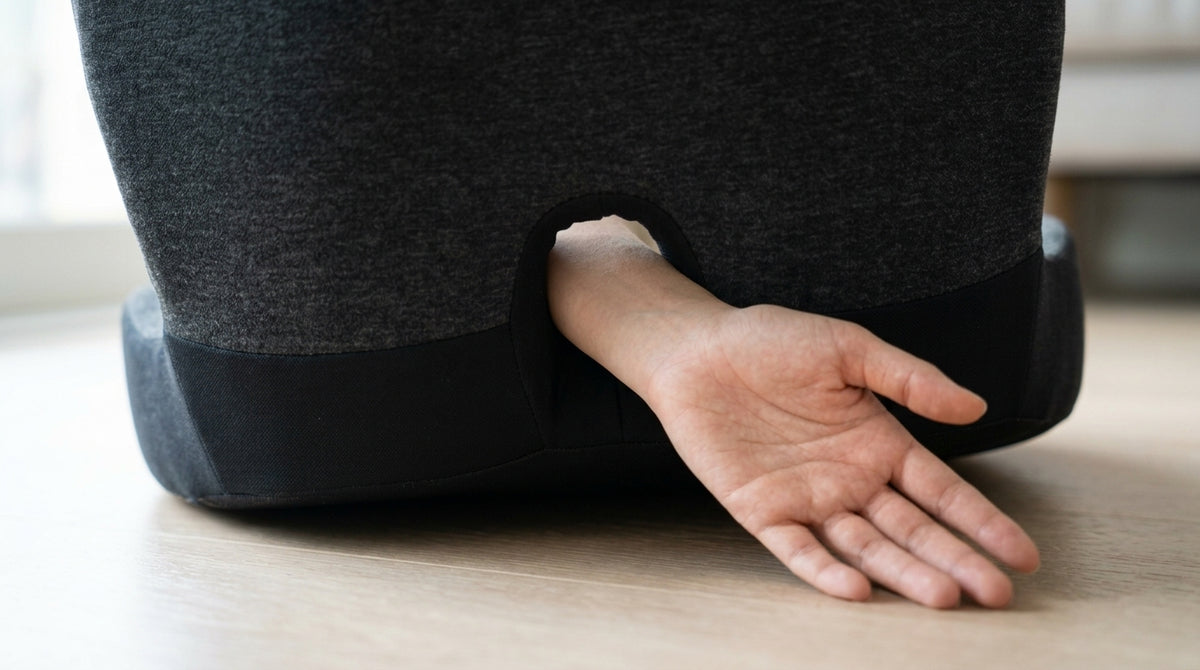
- 2 An actual gap, not a dipA U-shaped cutout at the rear. You can see through it. Where the tailbone goes there is no foam, no gel, no material — just air. Reach underneath and your whole hand fits.
- 3 Dense foam under the sit bonesI pressed it with my thumb and it pushed back. This was not the squishy foam from the truck stop. High-density, the kind that holds its shape at hour eleven.
Full rubber base
Not a smooth bottom, not fabric. Rubber, across the whole underside — the kind that grips a cloth truck seat and stays put when a loaded truck brakes hard.
17 inches wide
I measured his seat before I ordered, because I'd read the bad reviews on other cushions where wives said their husband's thighs hung off the edge. Seventeen inches was right.
The cover comes off
Unzips completely and goes in the machine. He's going to sit on this eleven hours a day for years.
I ordered the 3-pack. $134.95, free shipping, three cushions. One for the truck, one for his car, one for his recliner.
I didn't tell him. Three cushions in the garage teaches you not to announce number four. I put one on his truck seat on Sunday night while he was asleep, one in his car, one in his recliner.
Then I waited.
What came back
Monday · six hours into his shift
What did you put on my seat.
Him · 2:14 PMJust try it. Tell me tonight.
Me · 2:16 PMNo question mark. Like he was suspicious — like he'd been sitting on it for six hours waiting for it to fail the way everything else had failed, and it hadn't, and he didn't know what to do with that.
He called me from the truck stop after his shift.
He didn't say it was comfortable. He didn't say his back felt better. He didn't give me a product review.
I forgot about the seat today.
Him · end of the first shift
Fourteen years of driving. Three years of shifting every few minutes. Eight months of appointments. Three cushions in the garage. And on that shift, in the company truck he isn't allowed to modify, he forgot about the seat.
He didn't notice the cushion working. He noticed the problem not being there. He got to hour eight and realised he hadn't shifted once. He climbed out of the cab without standing on the step. He walked to the door without thinking about it.
He didn't feel something new. He stopped feeling something old.
I stood in the kitchen holding the phone for a long time after he hung up. Not crying. Just breathing. Three years of watching and researching and spending and failing — and the answer was a hole in a cushion and sixty-five dollars.
Three months later, specifically
Because "his back is better" is what everybody says and it means nothing. Here is what actually changed.
The bottle stopped emptying
He stopped taking it before his shift. I didn't tell him to and he never announced it. The bottle is still on the counter — it just isn't getting emptier. The thing that made him reach for it every morning isn't part of the morning now.
The appointments stopped
His chiropractor told us herself that the adjustment resets when the seat undoes it. Once the bone was over air instead of over foam, the thing undoing her work every shift wasn't happening. He decided on his own he didn't need to go back.
The step down
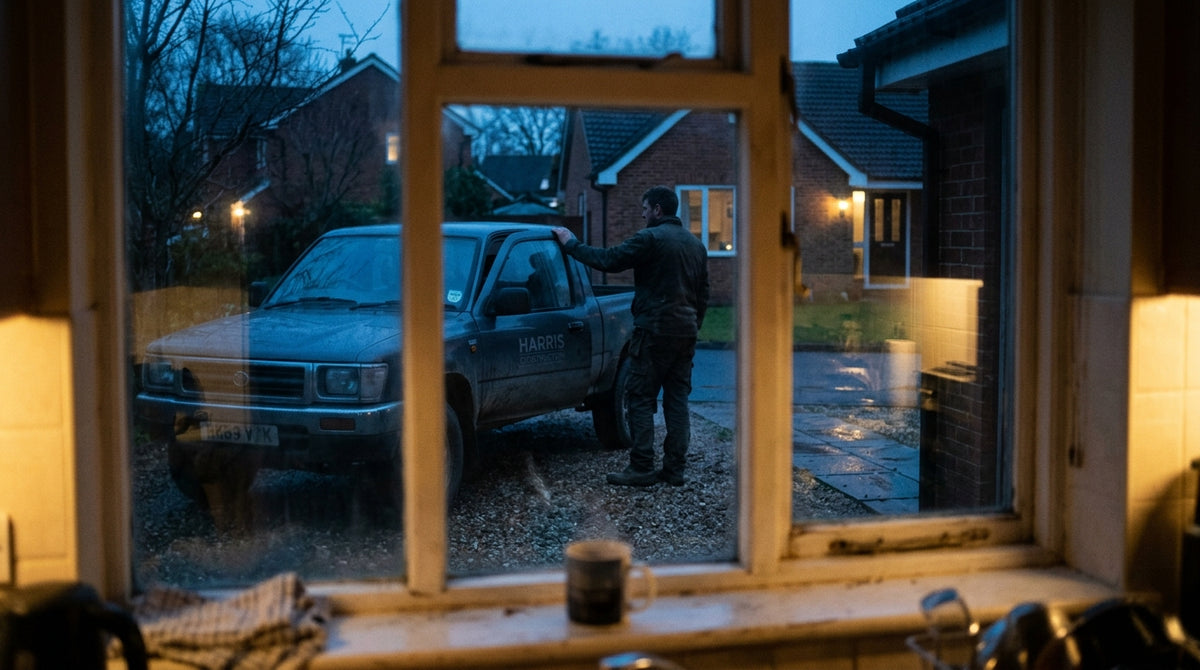
I watched him from the kitchen window last Tuesday. He stepped out of the cab in one motion. No grip on the door frame. No pause. No thirty seconds of waiting for something to release.
The drive home
Forty minutes each way on a flat car seat used to mean stretching in the driveway before he came inside. The car cushion fixed that. Now he just walks in.
The evenings
Three hours of football without shifting every ten minutes. He stays in the chair. He falls asleep in it sometimes — he never used to, because his body was never still enough to.
What didn't change
The roads are the same. The seat in that truck is the same worn factory seat. The fourteen-hour clock didn't get shorter. The job is still the job.
Same cushions, all three, from day one. The foam hasn't compressed. The cutout is still a cutout — there's nothing in it to wear out. The rubber base still grips. He has not adjusted it once.
What other drivers say
Not me, and not the company. These are verified-purchase reviews from trynemira.com — 4.5 out of 5 across 1,286 of them. Comfort opinions, in their words.
“I had already dropped the seat, dumped the air and moved my wallet out of my back pocket — all the things that half-work. This is the first one that changed how I feel climbing down at the end of a fourteen.”Daniel R. · OTR, 26 years
“Forty thousand miles. Same shape it was in the box. My last one was a pancake by month two.”Marcus C. · owner-operator, 7 months
“Every cushion I have owned was half on the floor by lunch. This one has not moved once.”Wes H. · route driver, 30–40 exits a day
“I stopped noticing my tailbone. That's the entire review.”Greg A. · 9 hours a day
“Bought one for the rig, then one for the pickup, then one for the recliner. Should have just bought the three-pack.”Tom B. · owner-operator
What I was worried about, in order
“What if it goes flat like the others?”
It can't go flat the way those did. They went flat because there was material under the tailbone and the bone compressed it. Here there is no material under the tailbone — nothing to compress, nothing to flatten, nothing to push through. The cutout is still a cutout at three months because air doesn't wear out.
The foam under the sit bones is high-density, not the squishy kind that conforms and then dies. Three months of eleven-hour shifts and it's the same firmness as day one.
“What if it's too narrow? He's a big guy.”
Seventeen inches. I checked before I ordered, because the one-star reviews on other cushions are full of wives saying their husband's thighs hung over the edge. Mine is 5'11" and 210 lbs and it fits him and fits the seat. If he fills his seat pan corner to corner, measure it first — thirty seconds with a tape measure saves a return.
“What if it slides around on the truck seat?”
Full rubber base, the whole underside, not four grip dots. He positioned it once on day one and hasn't touched it since — and he brakes twenty times a day hauling forty thousand pounds.
“He's over 240 lbs. Will it hold?”
Density is what matters, not thickness. Dense foam pushes back instead of conforming and dying. If you're unsure, order the single first and test it — the 60-day guarantee covers you either way.
“What if he hates it and it comes back after two days like the last one?”
Sixty days. Not thirty. In his actual truck, on his actual route, with his actual body, on the seat that killed every other cushion. If the foam compresses, send it back. If the cutout makes no difference, send it back. If the bone reaches the pan at hour six the way it does on everything else, send all three back and take every dollar.
I didn't need sixty days. I knew on the first shift. But if you need the runway, it's there.
The arithmetic that decided it
| What I spent before | Cost |
|---|---|
| Chiropractor — 16 visits over 8 months | $2,960 |
| "Trucker-rated" pad — pancaked in six weeks | $150 |
| Gel grid — slid, no back support | $65 |
| Memory foam from the truck stop | $28 |
| Air-ride seat — almost | $3,100 |
| The Nemira 3-Pack | $134.95 — once |
$3,203 on things that didn't hold. $134.95 on the thing that did. That's $44.98 a cushion — less than a single chiropractor visit, for every seat he sits in.
Why the 3-pack and not just the one
I almost ordered the single. $64.95, just for the truck, just to test it. That's what three cushions in the garage does to you — it makes you hedge.
Then I thought about his actual day. The truck is eleven hours. But the truck isn't where his day ends. He drives home — forty minutes on a flat car seat, same bone, same surface. Then he's in the recliner for three or four hours. Same bone. Same flat surface.
He's on a flat surface for sixteen hours a day. Fixing the truck and leaving the car and the chair is fixing eleven hours and undoing it for five more.
For the three seats he sits in Truck, car, recliner $134.95 $44.98 a cushion — free shippingLess than one chiropractor visit, for every seat he sits in. Sixty days to send all three back.Get the 3-Pack — $134.95 60-day guarantee · free shipping on 2 or more| Pack | Price | Per cushion | Shipping |
|---|---|---|---|
| 3-Pack — truck, car, recliner | $134.95 | $44.98 | Free |
| 2-Pack | $99.95 | $49.98 | Free |
| Single — start here to test | $64.95 | $64.95 | $4.95 |
Sixty days, in his actual truck
Not thirty. Sixty — on his route, with his body, on the seat that killed every other cushion. One email to return, full refund, no restocking fee, and you don't need the box.
Not "if it's defective." If it isn't right for him.
Two versions of the next six months
If you close this page
- You read another forty reviews tonight.
- You buy one more flat cushion — thicker this time, or more expensive. It works for three weeks.
- It joins the others in the garage.
- You book another appointment. It helps for two days, then the seat undoes it.
- You open the air-ride listing one more night and close the tab.
- You watch him grip the door frame. You watch the bottle get emptier.
- Six months from now nothing has changed. He's still shifting. You're still searching.
If you order tonight
- $134.95. You don't tell him.
- One goes on his truck seat before his next shift. One in the car. One in the recliner.
- Sometime that first day — hour four, maybe hour six — your phone buzzes and he asks what you put on his seat. Not grateful. Suspicious. He's waiting for it to fail.
- That night he says something small you almost miss. I didn't think about it today.
- Or he says nothing, and just sits down at the table without the grunt.
- Three months from now all three are still there — same density, same shape — and the garage is a story you tell your sister.
That's what $134.95 buys. Not a cushion. The end of the research. The end of the graveyard. The end of watching him grip the door frame every night.
He won't buy this for himself. You know that — it's why you're here. So buy it for him.

P.S.Measure his seat pan before you order — thirty seconds with a tape measure. Seventeen to eighteen inches is the fit. It's the one thing I'd check first, because it's the one complaint in every bad cushion review I read.
P.P.S.Don't tell him. Put it on the seat and say nothing. If you announce it he'll decide in advance that it won't work, the way he decided about the last three. Let the seat do the convincing.
P.P.P.S.If he's already had surgery, or he's on a list for it — nobody is telling you this fixes that, and don't let anyone sell you that it does. What I'm telling you is that the seat doesn't care what his back has already been through, and it's still eleven hours a day.
P.P.P.P.S.The offer in one line: $64.95 for one, $99.95 for two, $134.95 for three, free US shipping on two or more, sixty days to send them back if they aren't right.
This account is a composite narrative, written in the voice of a spouse buying for a professional driver and assembled from documented purchaser experiences — verified review histories, public forum threads and published occupational-health research. It is not the testimonial of one named individual, and the narrator is not a real named customer. The quoted reviews attributed to Daniel R., Marcus C., Wes H., Greg A. and Tom B. are real verified-purchase opinions about comfort and product experience from trynemira.com. The Nemira Orthopedic Cushion is a seating support product designed to redistribute seated body weight. It is not a medical device and is not intended to diagnose, treat, cure or prevent any disease or medical condition. Nothing here is medical advice, and the descriptions of chiropractic care, ibuprofen use and seated posture are general information rather than guidance for any individual. Individual comfort experiences vary. Prices quoted for competing products, chiropractic visits and aftermarket seats are illustrative examples of category costs, not quotations from any named seller. Consult a healthcare professional for medical concerns.