

Occupational health · Workaround analysis
5 Things Truckers Do for Tailbone Pain That Actually Make It Worse
The Foam Pad. The Ibuprofen. The One-Hip Lean. You Think They're Helping Your Tailbone. They're Not.
You've Tried Five Things for Your Tailbone. Here's Why None of Them Worked — and What They've Actually Been Doing to the Bone.
You have done at least three of these. They feel like they are helping. Here is what they are doing to the bone.

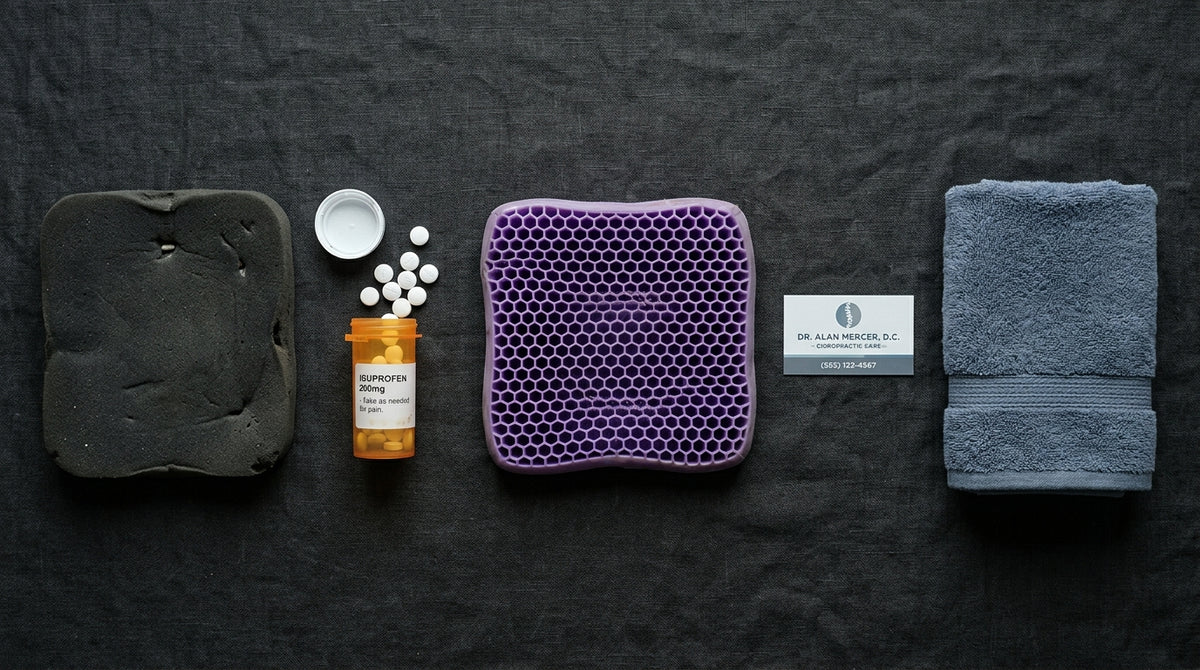
What this article establishes
- Five common workarounds, and at least three of them load the wrong bone harder — not "don't help." Make worse.
- Each one fights a single force and leaves the other two running. That is why none of them have held.
- Only one change alters which bone carries you. Everything else changes how that bone feels while it carries you.
Your tailbone hurts. You know it hurts. You are not in denial about it.
You've been managing it for years — shifting, popping ibuprofen, buying things, adjusting things, spending money on things. You are not sitting around waiting for it to fix itself. You are actively trying.
And at least three of the things you're doing are making it worse.
Not “not helping.” Making it worse. Actively loading the bone that shouldn't be carrying you, masking the signal that would tell you to stop, or trading one problem for another that's harder to trace back.
Here are the five. See how many you recognise.
-
01
The ibuprofen habit

800 mg, twice a day. Vitamin I. The same as a prescription dose.
A driver on a public forum“I currently take 800 mg 2x daily for arthritis… for about the last 2 years. I have my liver checked twice a year.”
You know the math — four 200 mg over-the-counter tablets. You take it because the alternative is parking early, and parking early costs about $84 a day.
Here is what it is doing. It is masking the signal from a bone that is taking load it was never built for. The bone is still taking that load. You just can't feel it. Every shift you pop 800 mg and drive through is another shift the tailbone absorbs 2,500 miles of vibration without complaint.
And chronic ibuprofen use pushes blood pressure up. So does chronic pain. So does the stress of wondering what the number will be at the next physical. Three forces pushing the same number — and all three trace back to the seat.
You are drugging the operator to compensate for the equipment, and the drug has a side effect that matters.
VerdictMasks the problem. Buys more time on the wrong bone. Pushes the number that decides the card. Worse on three axes.
-
02
The truck-stop foam pad
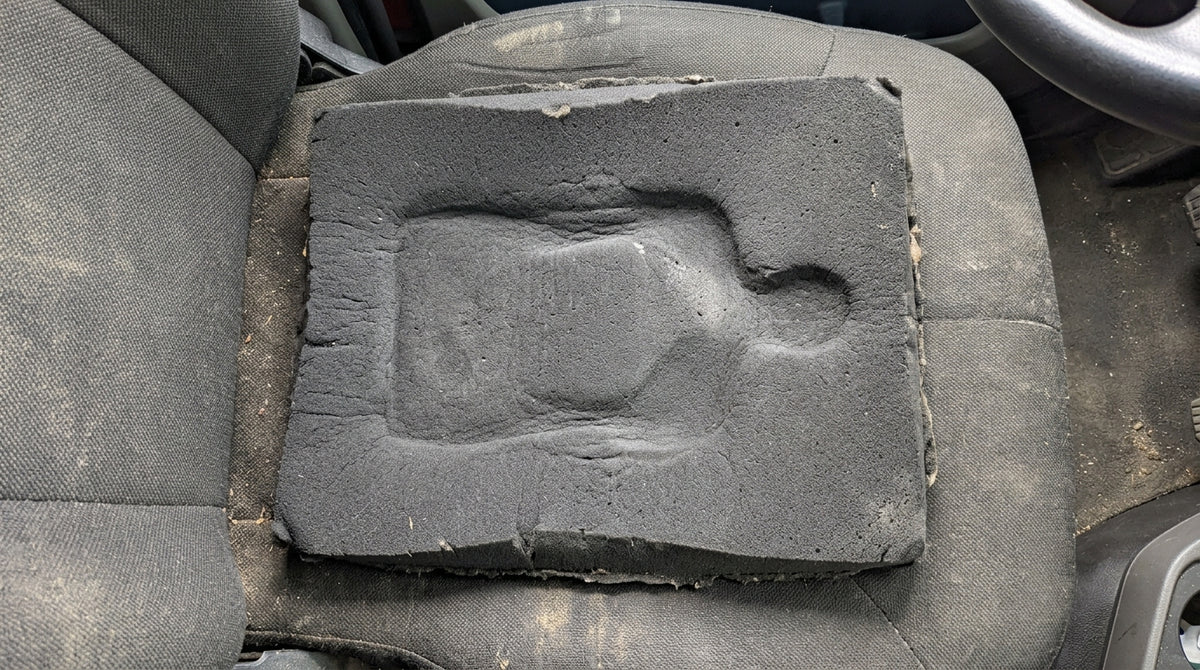
The one from Love's. Or Pilot. Or Amazon. Twenty-two bucks, felt amazing on day one. By week three it was a pancake and you were sitting through it onto the pan. So you bought another one. Same thing.
Here is why it makes it worse: false confidence. You bought a cushion. You believe you have addressed it. So you stop looking for a real fix.
A foam pad does not change which bone bears your weight. Your tailbone still sits on a surface — a slightly softer surface that gets less soft every day. The pelvis still rolls backward. The foam still bottoms out. And the one bone that should never carry load still carries all of it.
The pad addresses the sink, poorly and temporarily. It does nothing about the roll or the road. And when it goes flat you are back where you started — except now you have confirmed your own suspicion that cushions don't work.
VerdictSoftens the contact for 21 days. Doesn't change the load. Goes flat. And it teaches you that cushions are all junk — which is what keeps you from finding one that isn't.
-
03
The gel grid
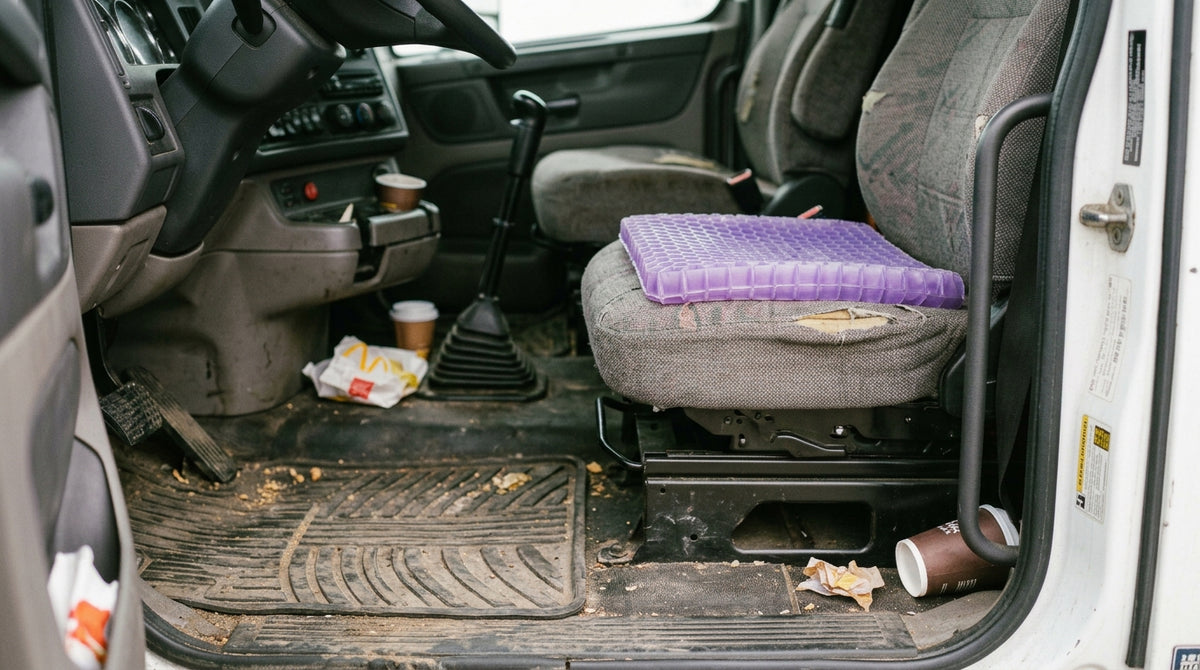
The purple one. Every guy on the forums swears by it, and for the first two days the tailbone does feel better.
By day three your mid-back is screaming. Here is why: gel shifts under load. Your body feels the instability, and your core and lower back fire to compensate — all day, for eleven hours. You traded a tailbone problem for a back problem.
It also wobbles on a truck seat, and every time you climb out it comes with you: half on the floor, half on the seat. The manufacturer's answer to that is rug tape.
The gel grid addresses the contact surface. That is one of three forces. It ignores the pelvis roll entirely — no back panel, nothing holding you upright — and it introduces a problem the seat did not have before: an unstable surface that makes your back work harder than the chair does.
VerdictFixes one force, creates a new problem, slides out on every exit. A $130 trade from tailbone pain to back pain.
-
04
The one-hip lean
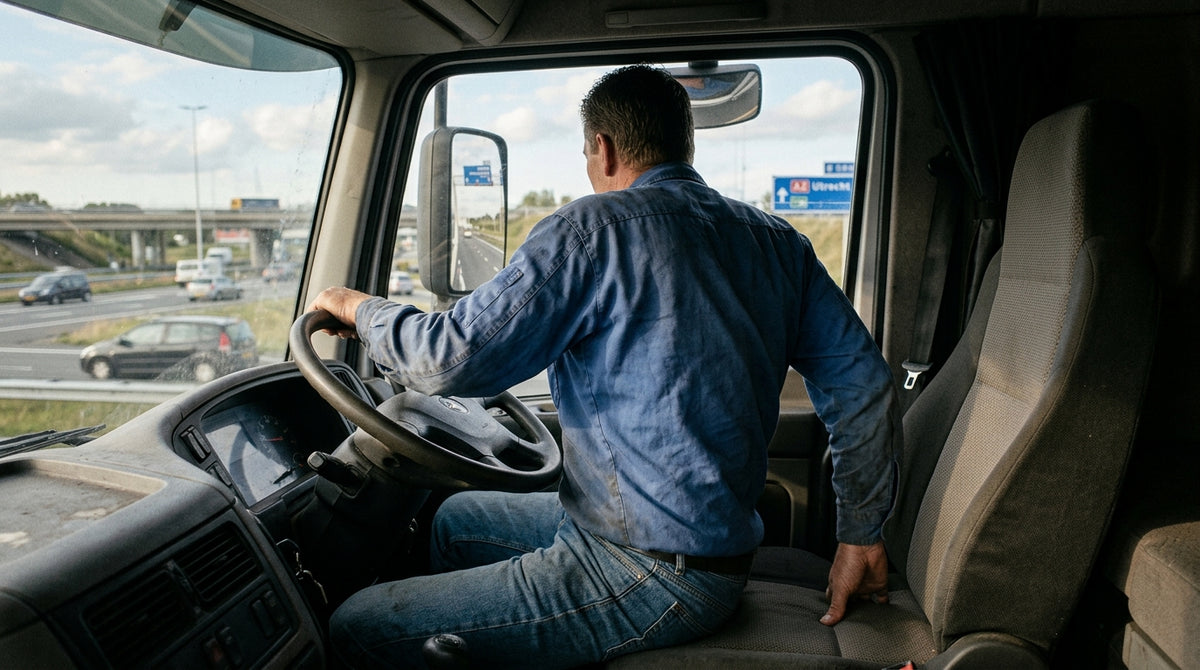
You do it without thinking. Hour five, you lean onto one hip to take the weight off the tailbone. Then the other hip. Then back. You have been doing it so long you don't remember deciding to start.
Here is what it is doing. Every minute you lean left, the right side of your pelvis lifts, and the compressive load on your lumbar spine goes asymmetric — one side carrying more than the other. Switch hips and the other side takes the hit.
Disc herniations at L4–L5 are not random failures. Ninety to ninety-five per cent of lumbar herniations happen at those two levels. Uneven loading under vibration is precisely the wrong thing to do to them.
The lean is your body's attempt to take weight off the bone. It works for a few minutes. In exchange it loads the lowest two vertebrae unevenly, 2,500 miles a week.
VerdictFree, involuntary, and it trades tailbone pressure for asymmetric spinal loading. Your body's own workaround is creating a second problem.
-
05
The chiropractor

You feel better walking out. Looser. Straighter. Good enough to think it is working.
Then you climb back into the same seat. The same flat pan. The same foam. The same bone carrying you for another 2,500 miles.
The chiropractor is not making it worse the way the ibuprofen is — the adjustment addresses real dysfunction. The problem is what it enables: you believe you are being treated, so the urgency to change the seat disappears.
Every adjustment addresses the result. It does not touch the cause. The seat books the next appointment before the adjustment has worn off. At $75 twice a month that is $1,800 a year maintaining a problem that restarts on the next shift; at $200 a visit it is $4,800. In both cases the return is close to zero, because the input has not changed.
VerdictTreats the effect, not the cause. $1,800+ a year to maintain a problem the seat re-creates every shift — and the appointment is what keeps you from fixing the equipment.
What all five have in common
None of them change which bone is carrying you.
The ibuprofen masks the signal from the bone. The foam pad softens the surface under the bone. The gel grid redistributes around the bone. The one-hip lean shifts load away from the bone — onto the vertebrae above it. The chiropractor resets the damage done by the bone.
It is still there. It is still carrying you. And it was never built for the job.
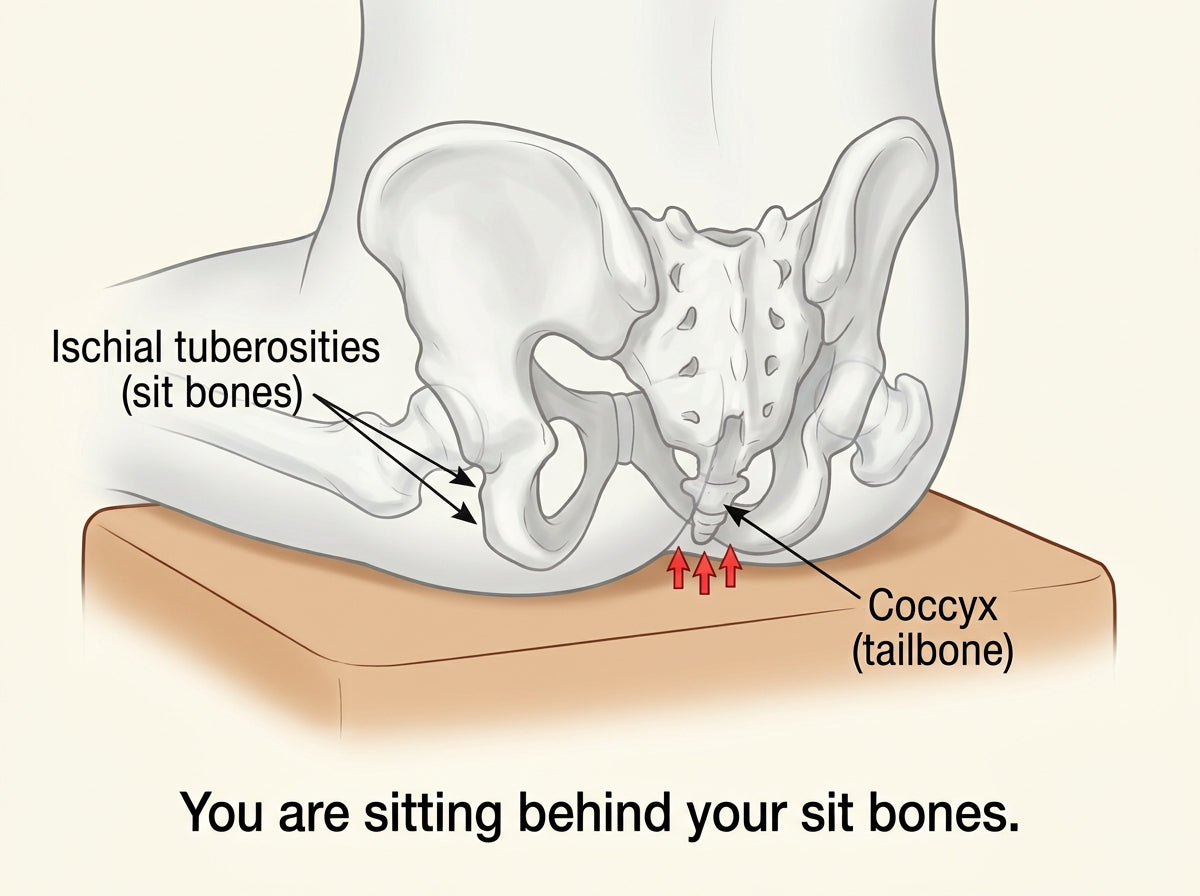
Your pelvis has two hard, flat contact points at the bottom — your sit bones. Sit on your hands and feel them pressing into your palms. That is where your weight was built to ride.
Every flat seat ignores both of them. Within ninety minutes the pelvis rolls backward, the lumbar curve flattens, and the weight slides off the sit bones and onto the coccyx — a curved bone at the base of the spine, the size of your thumb, no muscle over it, no fat pad, never designed to bear load.
Three things are happening in your seat, every shift, in this order.
-
1
The Roll
The pelvis tilts backward and the weight slides off the sit bones onto the coccyx. Every flat seat, within ninety minutes, regardless of price or adjustment.
-
2
The Sink
The foam under the coccyx bottoms out. That dip in your seat pan is the sink — years of one bone compressing the same square of foam until it stopped coming back. Softer foam fails faster.
-
3
The Road
Whole-body vibration turns steady pressure into thousands of small impacts on an unprotected bone. NIOSH classifies it as an occupational hazard. A factory air-ride removes roughly 10%. The other 90% rides through.
The stress on L4 and L5 in a rolled-back seated posture compared with standing — the two levels where 90–95% of disc herniations happen. Nearly three times the load, on a stationary chair, before you add vibration.
MDPI Bioengineering, 2023 — finite-element modelling of lumbar load by posture.Every one of the five things above fights one of these three and ignores the other two. That is why none of them have worked. That is why you are still shifting at hour six.
Ten seconds · in your own truck · right now
The palm test
Go to your truck. Sit down. Palm flat on the seat, an inch behind where your tailbone lands. Press hard — your full weight, not a poke.
Feel the hard pan underneath?
If your hand gets through, so does your tailbone. Every mile. That dip in the seat is the sink — your bone's signature in the foam — and it means the seat stopped protecting you a long time ago.
What would have to be different
To stop this at the bone, three things have to happen at once.
The coccyx comes off the surface
Not padded. Not softened. Removed from the equation — the bone sits over a gap and contacts nothing.
The weight transfers to the sit bones
The two hard points your pelvis was built around carry the load instead.
The pelvis stays upright
An integrated back panel holds it there. No separate pillow, no piece that slides down.
Miss one and the other two carry on. That is the whole reason five reasonable attempts left you exactly where you started.
The sixth thing on the list
One design hits all three at once. It is called the Nemira Orthopedic Cushion — and it belongs on this list for the opposite reason to the other five.
-
06
The one that changes the load
 1
2
3
1
2
3
- 1 One bodySeat and back panel are one piece of foam. Nothing separates. Nothing ends up behind the seat.
- 2 L-shaped cutoutThe tailbone contacts nothing. Reach under — your whole hand fits, daylight on the other side. The gap holds open under a heavy driver because the foam is dense enough to keep its shape.
- 3 Sit-bone padsHigh-density, high-ILD foam. Firm enough that your sit bones don't sink through, dense enough to still be there at hour eleven.
Derek K. · long-haul, two previous cushions“The back half of the last set spent more time on the floor of the cab than behind me. This one is the same piece of foam I am sitting on, so there is nothing to fall down.”
Marcus C. · owner-operator, 7 months, 40,000 miles“Same shape it was in the box. My last one was a pancake by month two.”
Wes H. · route driver, 30–40 exits a day“Every cushion I have owned was half on the floor by lunch. This one has not moved once.”
VerdictChanges which bone carries you. Hits all three forces. One piece — doesn't flatten, doesn't slide, doesn't create a new problem. And it is the only thing on this list you buy once.

The first ten seconds
You sit down and the pressure under your tailbone is gone — because the bone is over a gap instead of a surface. Either it is touching something or it isn't.
- 01
Day one
Firmer than you expect
That is the mechanism, not a defect — soft is what failed you. Drop your seat one notch and check your mirrors. Two minutes, once.
- 02
First week
A full leg without shifting
No hip hunting, no counting exits. And the ibuprofen bottle stays shut in the door pocket.
- 03
Week three
The climb down stops being a move
No lock-up. No stiffness. You just get out of the truck.
“I stopped noticing my tailbone. That's the entire review.”Greg A. · 9 hours a day
The 3-pack — because the bone doesn't clock out
The rig, eleven hours. The pickup, call it an hour. The recliner when you get home, call it three. That is fifteen hours a day, and one cushion covers eleven of them.
Don't tell yourself you'll carry one between them. You'll do it twice. Then it lives in the rig, and every hour you are not driving goes back to being unprotected.
Reader offer Save up to $60 OFF on the 3-pack — cab, pickup, home$134.95 for three against $194.85 buying three singles. Free US shipping on two or more, and sixty days to send them back.Claim $60 OFF 60-day guarantee · free shipping on 2 or more| Pack | Price | Per cushion | Shipping |
|---|---|---|---|
| 3-Pack — cab, pickup, home | $134.95 | $44.98 | Free |
| 2-Pack | $99.95 | $49.98 | Free |
| Single — start here to test | $64.95 | $64.95 | $4.95 |
Put it next to what the five things cost you
| What you are spending now | Annual |
|---|---|
| Parking 2 hrs early — 130 miles/day × $0.65 | ~$21,000 |
| Chiropractor, twice a month | $1,800–$4,800 |
| Foam pads, rebought monthly | $240–$360 |
| Ibuprofen, daily | $150–$300 |
| The gel grid — thrown out in a week | $130 |
| The Nemira 3-Pack | $134.95 — once |
Less than two chiropractor visits. Less than one day of parking early. And the only thing on that list you buy once.
60-Day Silent Tailbone Guarantee
Run it for 60 days. Any seat. 10,000 miles. If it isn't right for you, send one email, ship it back, full refund.
Not “if it's defective.” If it isn't right. You will know within the first ten seconds whether the pressure is gone. You have eight weeks.
One fix that hits all three
You have tried five things. Each one fought a single force and left the other two running. This is the sixth. It hits all three — and unlike the other five, you buy it once.

P.S.Run the palm test before you buy from anyone, including this. Sit down, palm flat an inch behind the tailbone, press hard. If you feel the pan, the seat stopped doing its job. That is the sink.
P.P.S.For the driver who has been through three pads and a gel grid and decided cushions don't work — you didn't try the wrong product. You tried the wrong approach. Every one of those puts softer padding between your tailbone and the seat, and the coccyx still carries you. This one takes the coccyx out of the equation. That is not a better cushion. It is a different design.
P.P.P.S.The offer in one line: $64.95 for one, $99.95 for two, $134.95 for three, free US shipping on two or more, sixty days to send it back if it isn't right.
The Nemira Orthopedic Cushion is a seating support product designed to redistribute seated body weight. It is not a medical device and is not intended to diagnose, treat, cure or prevent any disease or medical condition. It does not lower blood pressure, replace medication, or affect the outcome of a DOT physical. Nothing on this page is medical advice, and the descriptions of ibuprofen, chiropractic care and seated posture are general information, not guidance for your situation. Individual comfort experiences vary. Statistics cited are from published research: the whole-body-vibration classification and the ~10% seat-absorption figure are from NIOSH occupational-health research and describe seats, not this product; the L4/L5 loading figures are from finite-element modelling published in MDPI Bioengineering (2023). Income and cost figures are example calculations for educational context; actual earnings vary by carrier, lane and experience. Driver quotes drawn from public forum posts are paraphrased for context. All product reviews are verified-purchase opinions about comfort and product experience from trynemira.com. Consult a healthcare professional for medical concerns.